Books to read: Algorithms to Live By

This book is a solid read with ideas that apply to decision making across a broad spectrum of areas. The authors are able to make the math and conversation around algorithms map to life in well thought and articulated examples that should open your thinking to new ways to approach problems and opportunities.

A few sections that jumped out to me are referenced here or in the reviews, but I encourage you to take the book for a spin yourself.

The most prevalent critique of modern communications is that we are always connected; we’re not. The problem is that we are always buffered. The difference is enormous.

Algorithms to live by pp226

We are now consuming so much information, we cannot possibly process it all. We now queue information to consume, inhibiting real time engagement and leaving an inescapable feeling of “missing out” or need to “catch up”.

From Amazon:
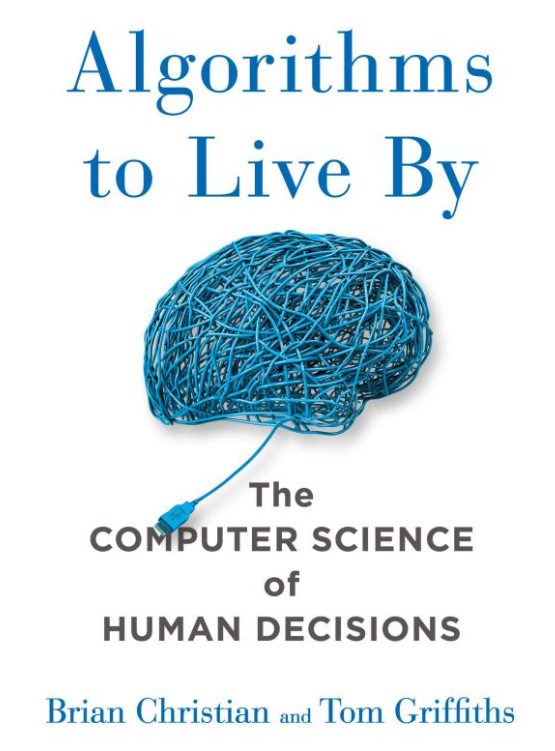
An exploration of how computer algorithms can be applied to our everyday lives to solve common decision-making problems and illuminate the workings of the human mind.

What should we do, or leave undone, in a day or a lifetime? How much messiness should we accept? What balance of the new and familiar is the most fulfilling? These may seem like uniquely human quandaries, but they are not. Computers, like us, confront limited space and time, so computer scientists have been grappling with similar problems for decades. And the solutions they’ve found have much to teach us.

In a dazzlingly interdisciplinary work, Brian Christian and Tom Griffiths show how algorithms developed for computers also untangle very human questions. They explain how to have better hunches and when to leave things to chance, how to deal with overwhelming choices and how best to connect with others. From finding a spouse to finding a parking spot, from organizing one’s inbox to peering into the future, Algorithms to Live By transforms the wisdom of computer science into strategies for human living.

https://www.amazon.com/Algorithms-Live-Computer-Science-Decisions/dp/1627790365

Why I recommend this book:

I lead teams in the Pharma / BioPharma industries and we grapple with large challenges on a regular basis – the ideas presented in the book resonate with me as I think about both the scientific / math applications, but as importantly, the human implications. As leaders it is often required that we know enough about everything in our area of responsibility to help guide the decision making for the organization(s). How we go about prioritizing what to focus on, what to allow in the queue vs what we allow to drop off is a critical bit of surviving and thriving. The best bets are made by those who can sperate the noise from the actionable data. To get there, we need to filter and extrapolate from what we have to what we need to do. This book helps shape a number of interesting and workable ideas to explore in this space.


Books to read: Sticky Wisdom: How to Start a Creative Revolution at Work

I got this book while working at Pfizer, and helping lead an innovation transformation in the consumer health division. We were looking to reboot out approach to product development and creativity in general, and as a part of that we invested in a great set of programs that I still benefit from now, long after those roles. This book is from the ?WhatIf! company, and has many little insights that can help unlock the creativity in you, and in your team.

The book asks a few key questions and offers accompanying insights to build on.

  • What if you could spot what’s killing creativity in your organization right now?

  • What if you could stop yourself squashing ideas and start growing them instead?

  • What if you could help everyone at work to be creative?

  • What if you stopped talking about how important creativity is and started to take practical steps to make it happen.

But most of all….  What if there was a step-by-step guide that showed you exactly how to do it?

Instinctively we all know that creativity at work is important,but for many of us it feels either difficult or intimidating.

Sticky Wisdom delivers powerful insights that take creativity out of the hands of ‘creative people’ and puts it back where it belongs, with all of us. It breaks creativity out into six practical behaviours and shows how every one of us – not just the wacky geniuses – is packed with creative potential. We can start a creative revolution by adopting six behaviours:

  1. Freshness
  2. Greenhousing
  3. Realness
  4. Momentum
  5. Signalling
  6. Courage

These are the behaviours you can identify in highly creative and high-performing teams. These are the behaviours that you can start applying today to revolutionize your life.

Suddenly creativity isn’t such a mystery. Sticky Wisdom makes it easy to talk about, easy to practise and easy to remember.Above all, it makes it easy to get on and do!

One of the points made in the book that makes great sense is the idea that creativity and innovation are not synonymous. Creativity only becomes innovation when the ideas are useful, or described another way, add value. The book is full of little stories and examples to make the point, as illustrated by an exercise with a food retailer team to have the team role play being a meal cooked in a wok. The book goes on to provide examples of the insights gained such as oil that changes color when ready, food that is pre-sliced and provided in numbered packages to sequence cooking properly, and more. These ideas came from the interactive role play and subsequent discussion. This type of activity generally takes me outside my comfort zone, as it does many, but that is the point.

In other posts, I reference the idea of stream jumping, which I got from this book and training. I also value the idea of Green Housing, which is broken into a series of steps outlined in the book consisting of:

  • Suspend Judgement
  • Understand
  • Nurture
  • React
  • Assume
  • INsist

Another key concept from this book, though not unique to the book, is signalling. Part of the accompanying training is around the value of being intentional with signalling to a partner in conversation what your intentions are, or where you are trying to take the conversation. This has been a valuable tool in my kit now for years, as I have learned to be much more clear with my intentions in communication, setting up my audience or partners to better receive and understand my messaging.

Why I recommend this book:

This book is full of great insights, and is a quick read. It can be used to bookmark and drop in and out of, or used as a reference to work through as a team. You cannot read this short reference without gaining value, even if you have extensive experience with change and innovation. It will spark ideas you have forgotten and give you new ones to build on. I cannot go into the full content of the book in a short post, but I encourage you to spend the few dollars it costs to buy this book. It was printed some time ago, but the ideas are as relevant today as when printed the first time!


Books to read:The Innovator’s Prescription: A Disruptive Solution for Health Care

This read is in line with the related book by the same author I also recommended titled “The Innovator’s Dilemma“. This book focuses on the healthcare industry, and besides Clayton Chritensen, includes 2 additional authors, Jerome Grossman, MD, and Jason Hwang, MD. The Amazon summary offers a decent overview.

A groundbreaking prescription for health care reform–from a legendary leader in innovation . . .

Our healthcare system is in critical condition. Each year, fewer Americans can afford it, fewer businesses can provide it, and fewer government programs can promise it for future generations.

We need a cure, and we need it now.

Harvard Business School’s Clayton M. Christensen―whose bestselling The Innovator’s Dilemma revolutionized the business world―presents The Innovator’s Prescription, a comprehensive analysis of the strategies that will improve health care and make it affordable.

Christensen applies the principles of disruptive innovation to the broken health care system with two pioneers in the field―Dr. Jerome Grossman and Dr. Jason Hwang. Together, they examine a range of symptoms and offer proven solutions.

YOU’LL DISCOVER HOW

  • “Precision medicine” reduces costs and makes good on the promise of personalized care

  • Disruptive business models improve quality, accessibility, and affordability by changing the way hospitals and doctors work

  • Patient networks enable better treatment of chronic diseases

  • Employers can change the roles they play in health care to compete effectively in the era of globalization

  • Insurance and regulatory reforms stimulate disruption in health care

And the editorial reviews are a good reflection of my thoughts as well:

  • “Clayton Christensen has done it again, writing yet another book full of valuable insights. The Innovator’s Prescription might just mark the beginning of a new era in health care.”Michael Bloomberg, Mayor, New York City

  • “Clear, entertaining, and provocative, The Innovator’s Prescription should be read by anyone who cares about improving the health and health care of all.”Dr. Risa Lavizzo-Mourey, President and CEO, Robert Wood Johnson Foundation

  • “Comprehensive in its vision, astute in its diagnosis, and clear in its guidance, The Innovator’s Prescription offers strong medicine for a health care system that is far from well.”Dr. Harvey V. Fineberg, President, Institute of Medicine

  • “A wealth of insights–with new ideas and revelations in every chapter. Read it, and you will be armed with solid ideas for making health care better.”George Halvorson, Chairman and CEO, Kaiser Foundation Health Plan, Inc. and Kaiser Foundation Hospitals

  • “The Innovator’s Prescription is a well researched, clearly organized road map to a sustainable health care system.”Michael O. Leavitt, Secretary of Health and Human Services

  • “The Innovator’s Prescription is an important and timely contribution to the national debate on health system reform. We would do well to consider it carefully.”Tom Daschle, former Senate Majority Leader and Distinguished Senior Fellow, Center for American Progress

  • “Clayton Christensen has helped many businesses―including our own–find new growth opportunities through deeper insights into the future of health and the health care system. I can think of no one better equipped to lead this comprehensive global assessment.”Bill Weldon, Chairman and CEO, Johnson & Johnson

Why I recommend this book:

I am in the healthcare industry (pharmaceutical / biopharma industry) and I found this book to be a fantastic challenge for where we are, and where we were. I read this one shortly after its release in 2009, and on reflection now, it is as relevant as it was at that time. Clayton and his co-authors take the foundation of the innovator’s dilemma, and apply that thinking to the healthcare space. The topics addressed include not only the opportunities to achieve value through innovative and lateral thinking, but also an exploration of the supply chain, hospital business models, chronic disease treatment and a broad range of additional topics. This should be required reading for management and management candidates in the healthcare related industries.


Books to read: The Innovator’s Dilemma

I first read this book many years ago and it has served as a good reference over the years, standing the test of time as a foundational work. First published in 1997 by Clayton Christensen and reprinted multiple times since, it details the business innovation cycles and the traps that are too easy to fall into.  The book has been superseded by new versions, but reading the original and early updates in contrast with how things have evolved as predicted is illuminating and sobering if you are in a large corporation. At the same time, those seeking to disrupt an existing industry will take heart and be encouraged by the principles outlined in this book. We have seen these ideas applied time and again with industry disruptions including Airbnb for the hotel industry, Uber, Lyft and others to the Taxi market, emerging financial market disruption with Bitcoin and more every day.

Editorial reviews from others:

  • The Innovator’s Dilemma is becoming a handbook for CEOs remaking their businesses for the Net.- BusinessWeek
  • The Innovator’s Dilemma captures the critical role of leadership in creating markets.- John Seely Brown, chief scientist, Xerox Corp., and director, Xerox Parc
  • This book ought to chill any executive who feels bulletproof – and inspire entrepreneurs aiming their guns.- Forbes
  • I cannot recommend this book strongly enough – ignore it at your peril.- Martin Fakley, Information Access
  • Absolutely brilliant. Clayton Christensen provides an insightful analysis of changing technology and its importance to a company’s future success.- Michael R. Bloomberg, CEO & Founder, Bloomberg Financial Markets
  • This book addresses a tough problem that most successful companies will face eventually. It’s lucid, analytical – and scary.- Dr. Andrew S. Grove, chairman & CEO, Intel Corporation
  • Clayton Christensen’s groundbreaking book…brings fresh insight and understanding to the complex and critically important relationships between technological change and business success…His conclusions provide food for thought for the top management of every company.- Richard N. Foster, Director, McKinsey & Company

From the back cover

In this revolutionary bestseller, innovation expert Clayton M. Christensen says outstanding companies can do everything right and still lose their market leadership—or worse, disappear altogether. And not only does he prove what he says, but he tells others how to avoid a similar fate.

Focusing on “disruptive technology,” Christensen shows why most companies miss out on new waves of innovation. Whether in electronics or retailing, a successful company with established products will get pushed aside unless managers know when to abandon traditional business practices. Using the lessons of successes and failures from leading companies, The Innovator’s Dilemma presents a set of rules for capitalizing on the phenomenon of disruptive innovation.

Find out:

  • When it is right not to listen to customers.
  • When to invest in developing lower-performance products that promise lower margins.
  • When to pursue small markets at the expense of seemingly larger and more lucrative ones.
  • Sharp, cogent, and provocative, The Innovator’s Dilemma is one of the most talked-about books of our time—and one no savvy manager or entrepreneur should be without.

Why I recommend this book:

As previously mentioned, this book was foundational in developing my thinking around innovation and change. It stands the test of time remarkably well and still serves as a business reference for both large corporations and disruptors alike. The cautionary tales from Xerox, Kodak and others as well as the success of the disruptors provides lessons that resonate with any business today. We are seeing disruption on a scale that feels unprecedented, and it would serve leaders well to learn from the errors and successes of their predecessors.