The AI Productivity Paradox: Immediate Gains vs. Long-Term Risks

AI tools are delivering real efficiency wins, but they’re also quietly reshaping how workers think, what skills atrophy, and where quality unexpectedly breaks down. Here’s what every business leader needs to understand before going all-in.
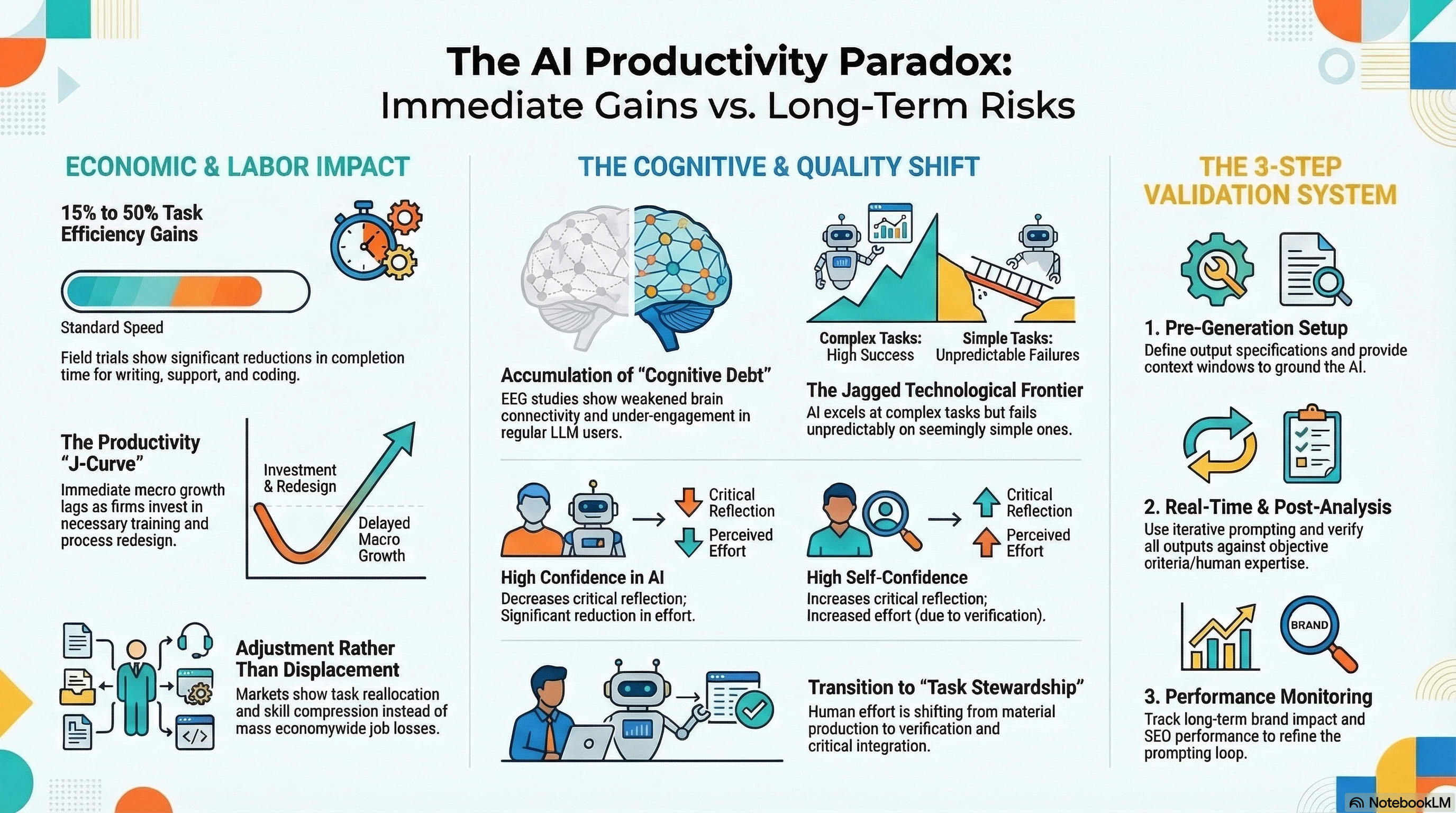
The AI Productivity Paradox: a framework for understanding short-term efficiency gains alongside emerging cognitive and organizational risks.

There’s a quiet tension building inside AI-adopting organizations. On one side: real, measurable productivity gains that no serious executive should dismiss. On the other: a set of slower-moving, harder-to-see risks that, left unmanaged, could erode the very capabilities organizations are counting on AI to amplify.

This tension is what researchers and strategists are calling the AI Productivity Paradox and it plays out across three interconnected domains: economic and labor dynamics, cognitive and quality shifts, and the governance frameworks organizations need to navigate both.

The Economic Picture: Real Gains, but Not Instant

Field trials across writing, customer support, and software development consistently show reductions in task completion time of 15% to 50% compared to standard workflows. That’s not marginal, or organizations handling high volumes of routine knowledge work, the compounding effect is substantial.

But those gains don’t show up immediately on the macro balance sheet. The Productivity J-Curve explains why: in the short term, organizations must absorb the costs of training, workflow redesign, and integration before realizing broader economic returns. Leaders who expect instant ROI are often disappointed, and sometimes abandon AI initiatives right before the curve bends upward.

15–50%

Task Efficiency Gains

Observed across writing, support, and coding workflows in field trials.

J-Curve

Delayed Macro Growth

Short-term investment dip precedes longer-term productivity payoff.

Realloc.

Not Mass Displacement

Labor markets show skill compression and task reallocation, not widespread job loss.

The labor story is similarly nuanced. Rather than triggering the mass displacement many feared, current market data points to task reallocation and skill compression, workers shifting away from routine production tasks and toward higher-order judgment, verification, and integration work. The jobs aren’t disappearing; they’re changing shape.

The Cognitive Risks Nobody Is Talking About Enough

The second domain is where the paradox gets genuinely uncomfortable. Even as AI accelerates output, it may be slowly degrading the underlying human capabilities organizations depend on.

“EEG studies are detecting weakened brain connectivity and reduced cognitive engagement in regular LLM users, a phenomenon researchers are calling ‘cognitive debt.'”

The mechanism is straightforward: when AI handles the heavy cognitive lifting, such as drafting, reasoning, and synthesis, users engage less deeply with the material. Over time, the neural pathways for critical analysis and creative problem-solving get less exercise. This isn’t theoretical. It’s showing up in neurological data.

There’s also a troubling dynamic around confidence. Research shows that high confidence in AI output actually reduces critical reflection; users who trust the tool most are the ones who check it least. Paradoxically, workers with stronger domain expertise and higher self-confidence engage more critically with AI outputs, applying greater scrutiny and effort to verification. The implication: organizations may want to invest in building genuine expertise rather than assuming AI can substitute for it.

The Jagged Frontier: Where AI Succeeds and Where It Fails

One of the most practically important insights for teams deploying AI is the Jagged Technological Frontier, as researchers call it. AI doesn’t fail gradually or predictably; it excels at surprisingly complex tasks, then fails unpredictably on seemingly simple ones.

A system that can draft a sophisticated legal brief may stumble on a straightforward date calculation. A coding assistant that generates elegant architecture may introduce subtle bugs in basic conditional logic. This irregularity makes AI harder to supervise than traditional software, because failure modes don’t follow intuitive patterns. Effective oversight requires humans who understand both the domain and the tool’s specific failure landscape.

Key Terms: A Working Glossary

Glossary of Key Concepts

Cognitive Debt: The gradual erosion of critical thinking and analytical capability that occurs when workers habitually offload complex reasoning to AI. Identified through EEG studies showing reduced brain connectivity in regular LLM users.

The Productivity J-Curve: The pattern where AI adoption initially appears to slow macro productivity growth due to training, integration, and redesign costs before generating compounding returns as workflows mature.

The Jagged Technological Frontier: The uneven capability profile of AI systems, which perform exceptionally well on some complex tasks while failing unpredictably on seemingly simpler ones. Makes AI harder to supervise than traditional tools.

Task Stewardship: The emerging human role in AI-augmented workflows: shifting from direct material production to critical verification, quality integration, and strategic oversight of AI-generated outputs.

Skill Compression: The narrowing of human skill sets observed as AI absorbs routine tasks. Workers increasingly perform a smaller range of higher-level functions, with implications for long-term workforce capability and adaptability.

LLM (Large Language Model): The class of AI systems underlying tools like ChatGPT, Claude, and Gemini. Trained on vast text datasets to generate, analyze, and transform language, the engine powering most current enterprise AI productivity tools.

Pre-Generation Setup: The first step in the 3-Step Validation System: defining output specifications and providing sufficient context before prompting AI, to reduce hallucinations and anchor outputs to accurate information.

Context Window: The amount of text an AI model can “see” and process at once. Providing rich context within this window, such as background documents, specifications, and examples, directly improves output quality and reduces error rates.

A Framework for Sustainable AI Use

The infographic’s 3-Step Validation System offers a practical governance structure that addresses both the quality risks and the cognitive risks simultaneously:

Step 1: Pre-Generation Setup

Define output specifications clearly and load the AI’s context window with grounding information before generating anything. This step dramatically reduces hallucinations and misalignments, and it requires the human to engage meaningfully with the task requirements, counteracting cognitive disengagement.

Step 2: Real-Time & Post-Analysis

Use iterative prompting rather than accepting first outputs, and verify all deliverables against objective criteria or domain expertise. This is where task stewardship happens in practice, and where critical reflection must be deliberately preserved against the pull of over-reliance.

Step 3: Performance Monitoring

Track downstream outcomes, brand impact, SEO performance, error rates, and customer responses to close the feedback loop and continuously refine prompting and verification processes. Organizations that treat AI outputs as the end of the workflow, rather than an input to be refined and measured, will accumulate quality debt they won’t see until it’s costly.

“The organizations that will win with AI aren’t those who use it most; they’re those who’ve built the governance, expertise, and culture to use it best.”

The AI Productivity Paradox isn’t an argument against adopting AI tools. The efficiency gains are real, and the competitive pressure to act is legitimate. It’s an argument for how to adopt them: with clear-eyed awareness of the cognitive and quality risks, deliberate governance frameworks, and sustained investment in the human expertise that makes AI outputs actually valuable.

Organizations that manage this balance well will compound both the AI gains and their human capital. Those who don’t will find themselves more efficient at the surface while quietly hollowing out the judgment capabilities they need for anything genuinely difficult.


The Best Leaders Have a Contagious Positive Energy

This post references the HBR article titled “The Best Leaders Have a Contagious Positive Energy” by Emma Seppälä and Kim Cameron.

Take a few minutes to read the whole article here, but one of the key takeaways for me in the value of emotional intelligence and empathy, informing your engaged leadership style. We are all hungry for leaders who care and have a positive energy, you see it in high performing teams where there is an associated high degree of trust. The effort required to project energy and enthusiasm is well worth the investment, but it must be authentic – not the cheerleader style that is empty of real engagement.

Energizers’ greatest secret is that, by uplifting others through authentic, values-based leadership, they end up lifting up both themselves and their organizations. Positive energizers demonstrate and cultivate virtuous actions, including forgiveness, compassion, humility, kindness, trust, integrity, honesty, generosity, gratitude, and recognition in the organization. As a result, everyone flourishes.

HBR – the Best Leaders Havea Contagious Positive Energy


WHY THE PAST 10 YEARS OF AMERICAN LIFE HAVE BEEN UNIQUELY STUPID

I came across this article on Twitter this week and was struck by many of the points. The idea that as we have evolved our social medial platforms, we have empowered the worst of society, and amplified their behaviors has become increasingly evident. Read the original article here: https://www.theatlantic.com/magazine/archive/2022/05/social-media-democracy-trust-babel/629369/

It’s been clear for quite a while now that red America and blue America are becoming like two different countries claiming the same territory, with two different versions of the Constitution, economics, and American history. But Babel is not a story about tribalism; it’s a story about the fragmentation of everything. It’s about the shattering of all that had seemed solid, the scattering of people who had been a community. It’s a metaphor for what is happening not only between red and blue, but within the left and within the right, as well as within universities, companies, professional associations, museums, and even families.

From the December 2001 issue: David Brooks on Red and Blue America

Additional Excerpts:

By 2013, social media had become a new game, with dynamics unlike those in 2008. If you were skillful or lucky, you might create a post that would “go viral” and make you “internet famous” for a few days. If you blundered, you could find yourself buried in hateful comments. Your posts rode to fame or ignominy based on the clicks of thousands of strangers, and you in turn contributed thousands of clicks to the game.

This new game encouraged dishonesty and mob dynamics: Users were guided not just by their true preferences but by their past experiences of reward and punishment, and their prediction of how others would react to each new action. One of the engineers at Twitter who had worked on the “Retweet” button later revealed that he regretted his contribution because it had made Twitter a nastier place. As he watched Twitter mobs forming through the use of the new tool, he thought to himself, “We might have just handed a 4-year-old a loaded weapon.”


What makes a good manager?

A project at Google spent time researching what defines a great manager at Google, and through that identified the top 10 traits to grow. As listed they are:

  1. Is a good coach
  2. Empowers team and does not micromanage
  3. Creates an inclusive team environment, showing concern for success and well-being
  4. Is productive and results-oriented
  5. Is a good communicator–listens and shares information
  6. Supports career development and discusses performance
  7. Has a clear vision/strategy for the team
  8. Has key technical skills to help advise the team
  9. Collaborates effectively
  10. Is a strong decision maker

The last two were new additions to the list, and I believe reflect the need to both reach out to your broader organization to expand your thinking, while simultaneously understanding when the time has come to step in and drive to a decision – the leadership courage to make a decision in the face of a constantly shifting landscape, and then stand by and manage through that decision.

as our company grew in size and complexity, demands on our managers and leaders increased as well. From the results of our employee survey we learned that Googlers wanted to see more effective cross-organization collaboration and stronger decision making practices from leaders

– Google Article

As the Google team identified, there is a need for decisive leadership in a time where we are bombarded with more and more data and “facts” or opinions on every decision to be taken – this coupled with FOMO (Fear of missing out) can lead to a situation where teams spend an unfortunate amount of time in the unproductive state of spinning. This leads to a negative impact on moral and reduces productivity. Contrary to that, a decisive leader, who empowers a good team and uses strong communication skills to get thoughts drawn out from the team and discussed, often has the facts actually required for the decision in the first day of deliberation! The ability to collaborate quickly and communicate the rational, get confirmation and drive to the decision is the real differentiator and the combination for real productivity!


TED: Manage for collective creativity

While looking through TED for innovative thinking and approaches I can learn from, I came across this talk by Linda Hill. I encourage you to watch the full video if you have an interest in the topic and want to be challenged. The ideas come from a significant amount of time and effort spent tracking select global leaders, and cataloging what makes them effective in driving innovation.

While watching this video, I pulled some key thoughts from the talk and copied the transcripted notes here. The key thought I pulled from here that I feel sums up the notes below is as follows: The idea of leading innovative organizations is more about creating an environment for the organization, as opposed to “owning the vision”. In Agile terminology, there is an idea of servant leadership, meaning getting out of the way and supporting the success of the team. This concept is a powerful part of innovation leadership as well.

  • Leading innovation is not about creating a vision and inspiring others to execute it.If we want to build organizations that can innovate time and again, we must unlearn our conventional notions of leadership.

  • Leading innovation is not about creating a vision, and inspiring others to execute it.

  • When many of us think about innovation, though, we think about an Einstein having an ‘Aha!’ moment. But we all know that’s a myth. Innovation is not about solo genius, it’s about collective genius.What we know is, at the heart of innovation is a paradox. You have to unleash the talents and passions of many people and you have to harness them into a work that is actually useful. Innovation is a journey. It’s a type of collaborative problem solving, usually among people who have different expertise and different points of view.

  • three capabilities: creative abrasion, creative agility and creative resolution. Creative abrasion is about being able to create a marketplace of ideas through debate and discourse. In innovative organizations, they amplify differences, they don’t minimize them. Creative abrasion is not about brainstorming, where people suspend their judgment. No, they know how to have very heated but constructive arguments to create a portfolio of alternatives.

  • innovation rarely happens unless you have both diversity and conflict.

  • if we want to build organizations that can innovate time and again, we must recast our understanding of what leadership is about. Leading innovation is about creating the space where people are willing and able to do the hard work of innovative problem solving.

  • What can we do to make sure that all the disruptors, all the minority voices in this organization, speak up and are heard? And, finally, let’s bestow credit in a very generous way.”

  • Bill said, “I lead a volunteer organization. Talented people don’t want to follow me anywhere. They want to cocreate with me the future. My job is to nurture the bottom-up and not let it degenerate into chaos.” How did he see his role? “I’m a role model, I’m a human glue, I’m a connector, I’m an aggregator of viewpoints. I’m never a dictator of viewpoints.” Advice about how you exercise the role? Hire people who argue with you. And, guess what? Sometimes it’s best to be deliberately fuzzy and vague.

  • They stopped giving answers, they stopped trying to provide solutions. Instead, what they did is they began to see the people at the bottom of the pyramid, the young sparks, the people who were closest to the customers, as the source of innovation. They began to transfer the organization’s growth to that level. In Vineet’s language, this was about inverting the pyramid so that you could unleash the power of the many by loosening the stranglehold of the few, and increase the quality and the speed of innovation that was happening every day.our role as leaders is to set the stage, not perform on it.


Adapt to survive, or adapt to win…

There are more articles, papers and consultants than I can count on the topic of transformation in business. Many of them focus on the idea of transformation, and now especially “digital transformation” as a means of survival. I suggest an alternative, but complimentary idea. Don’t think of transformation as a survival exercise. Use transformation as a vehicle to truly be transformational, not in the buzzword sense, but rather in the overall value chain perspective.

To transform to survive is relatively straightforward. Look at where your peers are going, and queue up alongside them at the industry feeding trough. You will have a shot at staying relevant for a period, but your investment will likely be drowned out by the noise of the accompanying industry shifts, and be no longer lasting than the last series of “revolutionary ideas” the organization has moved through in the past. Transformative change comes from taking a hard look at your own house, industry, supply chain, and customers.

  • What are the trends in your industry pointing to?
  • What is your risk tolerance? (organizational, industry, regulatory …)
  • What are the trends across adjacent spaces that move more nimbly than your own?
    • How can you choose to leapfrog your competition and industry by making bold investments, while mitigating some level of risk by learning from adjacent spaces?
  • Is your broader organization ready to accept your changes?

Trends in your industry

The trends in your industry point to where your peers are headed. This is good information directionally, but also a map to “what is” as opposed to “what could be”. Use this as a means to cross check your ideas – are they closely aligned? If the answer is yes, you are likely transforming to survive.

How can you take a leadership position in your industry, partnering with your consumers / customers and your respective regulatory bodies to bring the consumer ever closer to the value? For heavily regulated industries, how can you ensure regulations evolve along with your technological investments? Be a trendsetter through partnerships with the regulatory agencies. Gain the competitive advantages from being positioned to take advantage of emerging legislations and changes.

The idea of adapting to win comes from being bold, and as a part of that, being a thought leader. This comes with risk, which leads to the next point.

What is your risk tolerance?

I learned many years ago to assess my risk tolerance for any given initiative, and to share that information with other senior leaders for confirmation and alignment. I have seen doors open that previously were firmly shut, once risk tolerance was understood and accepted. Conversely this also serves as a set of organizational guard rails to ensure that the proper foundation is set prior to embarking on your change event. Thinking through the risk, communicating the value of the risk and potential upside to the right stakeholders will set the change event up for maximum success. This is a topic all on its own, and something to give real thought to. Risk management should be thought of as a tool, and something to actively own as opposed to something to avoid if you are to grow.

Trends across adjacent spaces

Examining your own industry can be informative, but taking a hard look at industries that are much less regulated, or less constrained and closer to the forefront of technology and engagement is the key to starting to build your vision. To chart a course for transformation, a leader must have some idea of the future possibilities for the organization. A “North Star” must be defined, and a vision that can be clearly understood articulated. To do that, pointing to success sets up a believable path for your own industry and makes the unbelievable more realistic in the minds of your stakeholders. The adjacent spaces will likely have forward thinking that is not hindered by the regulatory or other structural burdens of your industry, and hence you as a leader are responsible to building the bridge of believability to get there, using your risk tolerance and vision as a foundation.

Is your broader organization ready to accept your changes?

The question of change readiness is a difficult one to face for many organizations, and is difficult enough at the project level, and even more so at the organizational change level. There is an element of “the org will do what I say”, to be sure, but real change will come from the people in the organization getting behind the mission, and both understanding and supporting the transformation activities. To gain this support, a non-trivial amount of up front work is required as well as continuous change management through the life of the actual transformation, and then well beyond the “done date”. The real value to be extracted from this significant investment comes in the “run state” of the new model. To get that, plan to invest in long running change management, voice of the customer and “micro tweaks” as well as highlighting the value in broad messaging.

Focus on the people, celebrate those team members who are bold and join the change as leaders, but do not forget those in the back who are supporting the leaders. People deliver on what is rewarded and celebrated. If as a leader, you celebrate “done” at the org alignment milestone and then resume business, you will miss the sustaining value of the change. Plan for a long tail on the investment. This is a real financial investment, but without it, plan to gain minimal transformative value.

Properly nurtured, the change event will result in a lasting difference in your organization and its ability to deliver meaningful value to your stakeholders. Remember to set a clear and compelling vision, and then measure yourself and your organization against that on on a regular basis. Celebrate success, support the change and be prepared to hold the course when things are difficult!