The AI Productivity Paradox: Immediate Gains vs. Long-Term Risks

AI tools are delivering real efficiency wins, but they’re also quietly reshaping how workers think, what skills atrophy, and where quality unexpectedly breaks down. Here’s what every business leader needs to understand before going all-in.
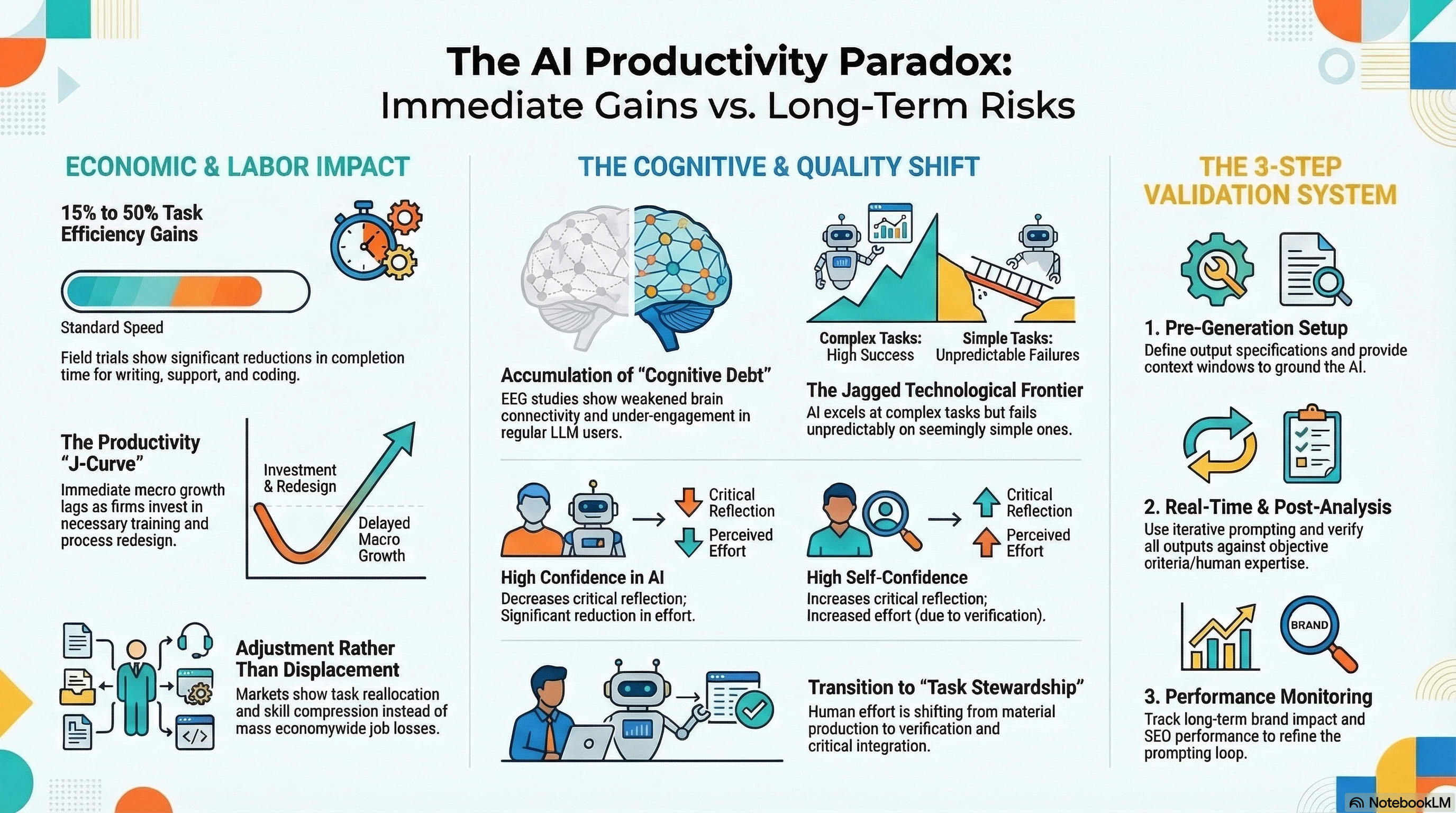
The AI Productivity Paradox: a framework for understanding short-term efficiency gains alongside emerging cognitive and organizational risks.

There’s a quiet tension building inside AI-adopting organizations. On one side: real, measurable productivity gains that no serious executive should dismiss. On the other: a set of slower-moving, harder-to-see risks that, left unmanaged, could erode the very capabilities organizations are counting on AI to amplify.

This tension is what researchers and strategists are calling the AI Productivity Paradox and it plays out across three interconnected domains: economic and labor dynamics, cognitive and quality shifts, and the governance frameworks organizations need to navigate both.

The Economic Picture: Real Gains, but Not Instant

Field trials across writing, customer support, and software development consistently show reductions in task completion time of 15% to 50% compared to standard workflows. That’s not marginal, or organizations handling high volumes of routine knowledge work, the compounding effect is substantial.

But those gains don’t show up immediately on the macro balance sheet. The Productivity J-Curve explains why: in the short term, organizations must absorb the costs of training, workflow redesign, and integration before realizing broader economic returns. Leaders who expect instant ROI are often disappointed, and sometimes abandon AI initiatives right before the curve bends upward.

15–50%

Task Efficiency Gains

Observed across writing, support, and coding workflows in field trials.

J-Curve

Delayed Macro Growth

Short-term investment dip precedes longer-term productivity payoff.

Realloc.

Not Mass Displacement

Labor markets show skill compression and task reallocation, not widespread job loss.

The labor story is similarly nuanced. Rather than triggering the mass displacement many feared, current market data points to task reallocation and skill compression, workers shifting away from routine production tasks and toward higher-order judgment, verification, and integration work. The jobs aren’t disappearing; they’re changing shape.

The Cognitive Risks Nobody Is Talking About Enough

The second domain is where the paradox gets genuinely uncomfortable. Even as AI accelerates output, it may be slowly degrading the underlying human capabilities organizations depend on.

“EEG studies are detecting weakened brain connectivity and reduced cognitive engagement in regular LLM users, a phenomenon researchers are calling ‘cognitive debt.'”

The mechanism is straightforward: when AI handles the heavy cognitive lifting, such as drafting, reasoning, and synthesis, users engage less deeply with the material. Over time, the neural pathways for critical analysis and creative problem-solving get less exercise. This isn’t theoretical. It’s showing up in neurological data.

There’s also a troubling dynamic around confidence. Research shows that high confidence in AI output actually reduces critical reflection; users who trust the tool most are the ones who check it least. Paradoxically, workers with stronger domain expertise and higher self-confidence engage more critically with AI outputs, applying greater scrutiny and effort to verification. The implication: organizations may want to invest in building genuine expertise rather than assuming AI can substitute for it.

The Jagged Frontier: Where AI Succeeds and Where It Fails

One of the most practically important insights for teams deploying AI is the Jagged Technological Frontier, as researchers call it. AI doesn’t fail gradually or predictably; it excels at surprisingly complex tasks, then fails unpredictably on seemingly simple ones.

A system that can draft a sophisticated legal brief may stumble on a straightforward date calculation. A coding assistant that generates elegant architecture may introduce subtle bugs in basic conditional logic. This irregularity makes AI harder to supervise than traditional software, because failure modes don’t follow intuitive patterns. Effective oversight requires humans who understand both the domain and the tool’s specific failure landscape.

Key Terms: A Working Glossary

Glossary of Key Concepts

Cognitive Debt: The gradual erosion of critical thinking and analytical capability that occurs when workers habitually offload complex reasoning to AI. Identified through EEG studies showing reduced brain connectivity in regular LLM users.

The Productivity J-Curve: The pattern where AI adoption initially appears to slow macro productivity growth due to training, integration, and redesign costs before generating compounding returns as workflows mature.

The Jagged Technological Frontier: The uneven capability profile of AI systems, which perform exceptionally well on some complex tasks while failing unpredictably on seemingly simpler ones. Makes AI harder to supervise than traditional tools.

Task Stewardship: The emerging human role in AI-augmented workflows: shifting from direct material production to critical verification, quality integration, and strategic oversight of AI-generated outputs.

Skill Compression: The narrowing of human skill sets observed as AI absorbs routine tasks. Workers increasingly perform a smaller range of higher-level functions, with implications for long-term workforce capability and adaptability.

LLM (Large Language Model): The class of AI systems underlying tools like ChatGPT, Claude, and Gemini. Trained on vast text datasets to generate, analyze, and transform language, the engine powering most current enterprise AI productivity tools.

Pre-Generation Setup: The first step in the 3-Step Validation System: defining output specifications and providing sufficient context before prompting AI, to reduce hallucinations and anchor outputs to accurate information.

Context Window: The amount of text an AI model can “see” and process at once. Providing rich context within this window, such as background documents, specifications, and examples, directly improves output quality and reduces error rates.

A Framework for Sustainable AI Use

The infographic’s 3-Step Validation System offers a practical governance structure that addresses both the quality risks and the cognitive risks simultaneously:

Step 1: Pre-Generation Setup

Define output specifications clearly and load the AI’s context window with grounding information before generating anything. This step dramatically reduces hallucinations and misalignments, and it requires the human to engage meaningfully with the task requirements, counteracting cognitive disengagement.

Step 2: Real-Time & Post-Analysis

Use iterative prompting rather than accepting first outputs, and verify all deliverables against objective criteria or domain expertise. This is where task stewardship happens in practice, and where critical reflection must be deliberately preserved against the pull of over-reliance.

Step 3: Performance Monitoring

Track downstream outcomes, brand impact, SEO performance, error rates, and customer responses to close the feedback loop and continuously refine prompting and verification processes. Organizations that treat AI outputs as the end of the workflow, rather than an input to be refined and measured, will accumulate quality debt they won’t see until it’s costly.

“The organizations that will win with AI aren’t those who use it most; they’re those who’ve built the governance, expertise, and culture to use it best.”

The AI Productivity Paradox isn’t an argument against adopting AI tools. The efficiency gains are real, and the competitive pressure to act is legitimate. It’s an argument for how to adopt them: with clear-eyed awareness of the cognitive and quality risks, deliberate governance frameworks, and sustained investment in the human expertise that makes AI outputs actually valuable.

Organizations that manage this balance well will compound both the AI gains and their human capital. Those who don’t will find themselves more efficient at the surface while quietly hollowing out the judgment capabilities they need for anything genuinely difficult.



The Best Leaders Have a Contagious Positive Energy

This post references the HBR article titled “The Best Leaders Have a Contagious Positive Energy” by Emma Seppälä and Kim Cameron.

Take a few minutes to read the whole article here, but one of the key takeaways for me in the value of emotional intelligence and empathy, informing your engaged leadership style. We are all hungry for leaders who care and have a positive energy, you see it in high performing teams where there is an associated high degree of trust. The effort required to project energy and enthusiasm is well worth the investment, but it must be authentic – not the cheerleader style that is empty of real engagement.

Energizers’ greatest secret is that, by uplifting others through authentic, values-based leadership, they end up lifting up both themselves and their organizations. Positive energizers demonstrate and cultivate virtuous actions, including forgiveness, compassion, humility, kindness, trust, integrity, honesty, generosity, gratitude, and recognition in the organization. As a result, everyone flourishes.

HBR – the Best Leaders Havea Contagious Positive Energy


Books to read: Algorithms to Live By

This book is a solid read with ideas that apply to decision making across a broad spectrum of areas. The authors are able to make the math and conversation around algorithms map to life in well thought and articulated examples that should open your thinking to new ways to approach problems and opportunities.

A few sections that jumped out to me are referenced here or in the reviews, but I encourage you to take the book for a spin yourself.

The most prevalent critique of modern communications is that we are always connected; we’re not. The problem is that we are always buffered. The difference is enormous.

Algorithms to live by pp226

We are now consuming so much information, we cannot possibly process it all. We now queue information to consume, inhibiting real time engagement and leaving an inescapable feeling of “missing out” or need to “catch up”.

From Amazon:

An exploration of how computer algorithms can be applied to our everyday lives to solve common decision-making problems and illuminate the workings of the human mind.

What should we do, or leave undone, in a day or a lifetime? How much messiness should we accept? What balance of the new and familiar is the most fulfilling? These may seem like uniquely human quandaries, but they are not. Computers, like us, confront limited space and time, so computer scientists have been grappling with similar problems for decades. And the solutions they’ve found have much to teach us.

In a dazzlingly interdisciplinary work, Brian Christian and Tom Griffiths show how algorithms developed for computers also untangle very human questions. They explain how to have better hunches and when to leave things to chance, how to deal with overwhelming choices and how best to connect with others. From finding a spouse to finding a parking spot, from organizing one’s inbox to peering into the future, Algorithms to Live By transforms the wisdom of computer science into strategies for human living.

https://www.amazon.com/Algorithms-Live-Computer-Science-Decisions/dp/1627790365

Why I recommend this book:

I lead teams in the Pharma / BioPharma industries and we grapple with large challenges on a regular basis – the ideas presented in the book resonate with me as I think about both the scientific / math applications, but as importantly, the human implications. As leaders it is often required that we know enough about everything in our area of responsibility to help guide the decision making for the organization(s). How we go about prioritizing what to focus on, what to allow in the queue vs what we allow to drop off is a critical bit of surviving and thriving. The best bets are made by those who can sperate the noise from the actionable data. To get there, we need to filter and extrapolate from what we have to what we need to do. This book helps shape a number of interesting and workable ideas to explore in this space.


WHY THE PAST 10 YEARS OF AMERICAN LIFE HAVE BEEN UNIQUELY STUPID

I came across this article on Twitter this week and was struck by many of the points. The idea that as we have evolved our social medial platforms, we have empowered the worst of society, and amplified their behaviors has become increasingly evident. Read the original article here: https://www.theatlantic.com/magazine/archive/2022/05/social-media-democracy-trust-babel/629369/

It’s been clear for quite a while now that red America and blue America are becoming like two different countries claiming the same territory, with two different versions of the Constitution, economics, and American history. But Babel is not a story about tribalism; it’s a story about the fragmentation of everything. It’s about the shattering of all that had seemed solid, the scattering of people who had been a community. It’s a metaphor for what is happening not only between red and blue, but within the left and within the right, as well as within universities, companies, professional associations, museums, and even families.

From the December 2001 issue: David Brooks on Red and Blue America

Additional Excerpts:

By 2013, social media had become a new game, with dynamics unlike those in 2008. If you were skillful or lucky, you might create a post that would “go viral” and make you “internet famous” for a few days. If you blundered, you could find yourself buried in hateful comments. Your posts rode to fame or ignominy based on the clicks of thousands of strangers, and you in turn contributed thousands of clicks to the game.

This new game encouraged dishonesty and mob dynamics: Users were guided not just by their true preferences but by their past experiences of reward and punishment, and their prediction of how others would react to each new action. One of the engineers at Twitter who had worked on the “Retweet” button later revealed that he regretted his contribution because it had made Twitter a nastier place. As he watched Twitter mobs forming through the use of the new tool, he thought to himself, “We might have just handed a 4-year-old a loaded weapon.”


Algorithms for decision making: Free book download from MIT

MIT press has provided a free book on Algorithms for decision making. You can download it from MIT Press here, or alternatively it is available from this site if the original link fails.

From the data science website:

The book takes an agent based approach
An agent is an entity that acts based on observations of its environment. Agents may be physical entities, like humans or robots, or they may be nonphysical entities,such as decision support systems that are implemented entirely in software. The interaction between the agent and the environment follows an observe-act cycle or loop.

  • The agent at time t receives an observation of the environment
  • Observations are often incomplete or noisy;
  • Based in the inputs, the agent then chooses an action at through some decision process.
  • This action, such as sounding an alert, may have a nondeterministic effect on the environment.
  • The book focusses on agents that interact intelligently to achieve their objectives over time.
  • Given the past sequence of observations and knowledge about the environment, the agent must choose an action at that best achieves its objectives in the presence of various sources of uncertainty including:
  1. outcome uncertainty, where the effects of our actions are uncertain,
  2. model uncertainty, where our model of the problem is uncertain,
  3. 3. state uncertainty, where the true state of the environment is uncertain, and
  4. interaction uncertainty, where the behavior of the other agents interacting in the environment is uncertain.

The book is organized around these four sources of uncertainty.

Making decisions in the presence of uncertainty is central to the field of artificial intelligence


Is your Scientific Data FAIR

For many years, we have seen the proliferation of data as we increasingly instrument our scientific processes. We have developed a diverse landscape of tools and processes, making significant leaps from paper based documentation, but created a new nightmare of integration and complex analysis. The FAIR initiative or set of principles is a framework to reduce that complexity through the application of a core set of principles outlined below, making data machine readable across sources. This unlocks the data from the proprietary structure and system walls, and offers a foundation to build interconnected analysis and insights.

Reference this excerpt from the abstract here that summarizes quite nicely what the objective is:

There is an urgent need to improve the infrastructure supporting the reuse of scholarly data. A diverse set of stakeholders—representing academia, industry, funding agencies, and scholarly publishers—have come together to design and jointly endorse a concise and measurable set of principles that we refer to as the FAIR Data Principles. The intent is that these may act as a guideline for those wishing to enhance the reusability of their data holdings. Distinct from peer initiatives that focus on the human scholar, the FAIR Principles put specific emphasis on enhancing the ability of machines to automatically find and use the data, in addition to supporting its reuse by individuals.

https://www.nature.com/articles/sdata201618#Abs1

The FAIR Guiding Principles

To be Findable:

F1. (meta)data are assigned a globally unique and persistent identifier
F2. data are described with rich metadata (defined by R1 below)
F3. metadata clearly and explicitly include the identifier of the data it describes
F4. (meta)data are registered or indexed in a searchable resource

To be Accessible:

A1. (meta)data are retrievable by their identifier using a standardized communications protocol
A1.1 the protocol is open, free, and universally implementable
A1.2 the protocol allows for an authentication and authorization procedure, where necessary
A2. metadata are accessible, even when the data are no longer available

To be Interoperable:

I1. (meta)data use a formal, accessible, shared, and broadly applicable language for knowledge representation.
I2. (meta)data use vocabularies that follow FAIR principles
I3. (meta)data include qualified references to other (meta)data

To be Reusable:

R1. meta(data) are richly described with a plurality of accurate and relevant attributes
R1.1. (meta)data are released with a clear and accessible data usage license
R1.2. (meta)data are associated with detailed provenance
R1.3. (meta)data meet domain-relevant community standards

There are an increasing number of resources targeted at supporting the movement to FAIR data, a couple of which are included here to get you started. There is much to cover on this topic, but these links and materials are a start on the conversation.

https://www.pistoiaalliance.org/projects/current-projects/fair-implementation/

References


Design Thinking

Design thinking is an approach that can be stand alone or a critical part if an agile delivery approach. It is at it’s heart, about inspecting and adapting, using iterative approaches to build value. The approach offers a number of great benefits, to include:

  • Quicker Starts – Since there does not need to be a robust final design spec prior to starting the iteration process, the team can get to real value much more quickly, focusing on the priority items as opposed to everything at once.
  • Clarity on purpose / objective – as the team starts the design process, the iterative and testing nature will help the group and owner try and discard multiple ideas and approaches, honing in on the highest value and driving clarity on what is important, as well as what is urgent, meaning a priority for initial value focus.
  • Needs driven development / investment – This is really an outcome of the prior value. As clarity and priority is achieved, the team will focus on what is next in line, and delivering the most value to the target outcome.
  • Reduction in “pet features”, meaning the ability to iteratively add value, and not have to have everything you MIGHT need defined up front prior to requirements lock allows product owners to be more selective in what they allow into the development cycle.  
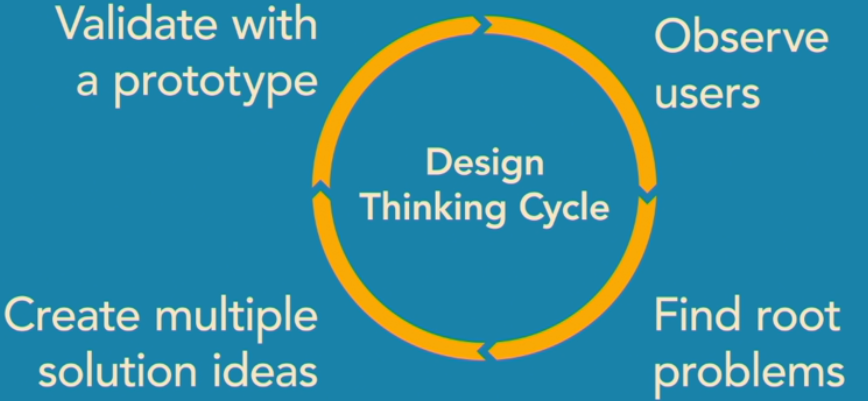
Design Thinking Flow
Image Source: Presentation from Chris Nodder

To be successful, the product owner and lead needs to set clear goals as well as success, or acceptance criteria for these. As these are declared, the team must measure the results, early & often. This feedback on results loop will allow the team to test the ideas and have value stories to tell, with real world feedback that is incredibly powerful.

Having led teams and worked in large enterprises for a couple of decades, I see many people who are a bit jaded and do not see themselves as creative. What I have found though, is that most people are creative when properly stimulated and often welcome the opportunity to contribute and be a part of a solution and ideation process. As a design thinker, it is important to learn to harness this process and enthusiasm. The white board and sticky note approach, as well as sketching on paper provides safe ways to start the ideation, and can open the door to creative thinking.

The low fidelity ideation drives collaboration and conversation, while also saving money and time. Paper prototypes are a great way to do an idea walk through and pressure test User Interface (UI) or work flows.

The risk of the waterfall mentality, meaning the standard step wise life cycle methodology is real, but can be mitigated to some level but following a lean / agile approach with an iterative startup phase. 

The value of failing fast, applying learnings is tremendous, as described previously. You can expect to see results such as:

  • Clearer cost estimation – ideas are tested and thought through
  • Reduced risk – fast failure is much lest costly failure
  • Improved Communication – the high collaboration required for design thinking forces good communication from the start, creating a solid foundation for a team to interact across levels. 
  • Faster time to market, with the highest value elements. – there is still a long tail, but the work is now focused on the value elements as opposed to the waste, and the team can terminate once the target value or capability has been met, as opposed to building, debugging and testing features that are no longer useful.

Getting started does not require a large enterprise commitment, or even a strong management endorsement. Just start – don’t make it a big deal or seek to justify, let the results do the speaking / marketing for your team. People are attracted to success, and success breeds more success creating a “pull through”.

As the thinking and process takes hold, you can work on the organization sell through. 

  • By identifying key influencers from each group you work with, you can make them part of the process, and part owners of the success. 
  • Meet face to face and explain the process, as well as the value. The face time allows you to pull out some paper and a pencil, and walk through the approach, demonstrating the design thinking in your message!
  • As you engage, explore the dominate challenges with the current process that your team or stake holder are familiar with. There are usually a number of clear pain points around start up time, risk incurred, long “dark windows” of development time, and long tails of debugging and delays.
  • The conversation opens the door to explain & explore how design thinking removes or mitigates those issues by providing much tighter engagement, ownership and communication as well as a value focus!

There is so much more that can be said on this topic, as well as the clear intersection with the agile world and approach, but this is a good initial exploration to get you started on the journey.


Agile Manifesto

The Manifesto for Agile Software Development came out of a discussion among 17 people in the Utah mountains. The story around the start in the Snowbird  ski resort is an interesting read, but fundamentally it is about looking for a better way of doing software development, and by extension, almost any other delivery activity.

Agile is a simple idea at its heart, though an entire industry has sprung up around the idea and approach, in many cases, making it anything but agile!

The Manifesto for Agile Software Development is as follows

We are uncovering better ways of developing
software by doing it and helping others do it.
Through this work we have come to value:

Individuals and interactions over processes and tools
Working software over comprehensive documentation
Customer collaboration over contract negotiation
Responding to change over following a plan

That is, while there is value in the items on the right, we value the items on the left more.


Principles behind the Agile Manifesto

The Agile Manifesto is backed or supported by 12 principles that describe the implementation approach. As mentioned in a related post, Agile is often blown up to a far more complex idea, with a misguided thinking that to be agile it means certain tools, specific techniques or other miscellaneous trivia. At its heart, the idea is simple and compelling. Breaking down the principles makes that clear, as you can see the roots in other approaches rolled up into this manifesto and related principles.

We follow these principles:  (Emphasis added by me)

  1. Our highest priority is to satisfy the customer through early and continuous delivery of valuable software.
  2. Welcome changing requirements, even late in development. Agile processes harness change for the customer’s competitive advantage.
  3. Deliver working software frequently, from a couple of weeks to a couple of months, with a preference to the shorter timescale.
  4. Business people and developers must work together daily throughout the project.
  5. Build projects around motivated individuals. Give them the environment and support they need, and trust them to get the job done.
  6. The most efficient and effective method of conveying information to and within a development team is face-to-face conversation.
  7. Working software is the primary measure of progress.
  8. Agile processes promote sustainable development. The sponsors, developers, and users should be able to maintain a constant pace indefinitely.
  9. Continuous attention to technical excellence and good design enhances agility.
  10. Simplicity–the art of maximizing the amount of work not done–is essential.
  11. The best architectures, requirements, and designs emerge from self-organizing teams.
  12. At regular intervals, the team reflects on how to become more effective, then tunes and adjusts its behavior accordingly.

Agile takes multiple forms, and a couple of the most common are the foundations of many more. Kanban is a more sequence driven form, and Scrum is probably the most common team & sprint based approach. 

There are a variety of tools used to aid in the management of agile projects, but the clear leader is the Atlassian tool called Jira. Of course, Excel is a fast follower as well in the spirit of keeping it simple!

I will post more on this topic, as I am in the middle of helping to drive an Agile Transformation in our enterprise R&D area. We have baselined our current approach and now my team is asking “why not agile” as opposed to “why agile” or assuming waterfall as the delivery process. 


Project Aristotle – Making Great Teams

Google researchers undertook a project to understand what makes a good team. The project was called Aristotle, after the quote “the whole is greater than the sum of its parts”. I find the results intriguing, as it was not stacked with what you might classically think of as drivers for team performance. The full story can be found here, but I will hit the highlights in this post.

The group went through the first step of defining what is a team, and from there, moved to what defines an effective team. The researchers measured team effectiveness in four different ways:

  • Executive evaluation of the team
  • Team leader evaluation of the team
  • Team member evaluation of the team
  • Sales performance against quarterly quota

The qualitative evaluations helped capture a nuanced look at results and culture, but had inherent subjectivity. On the other hand, the quantitative metrics provided concrete team measures, but lacked situational considerations. These four measures in combination, however, allowed researchers to home in on the comprehensive definition of team effectiveness.

SOURCE: THE REWORK STUDY

The team ran studies across a large population of teams and narrowed down the determining factors to a handful of key attributes. Following is a summary from that section of the research.

The researchers found that what really mattered was less about who is on the team, and more about how the team worked together. In order of importance:

Psychological safety: Psychological safety refers to an individual’s perception of the consequences of taking an interpersonal risk or a belief that a team is safe for risk taking in the face of being seen as ignorant, incompetent, negative, or disruptive. In a team with high psychological safety, teammates feel safe to take risks around their team members. They feel confident that no one on the team will embarrass or punish anyone else for admitting a mistake, asking a question, or offering a new idea.

Dependability: On dependable teams, members reliably complete quality work on time (vs the opposite – shirking responsibilities).

Structure and clarity: An individual’s understanding of job expectations, the process for fulfilling these expectations, and the consequences of one’s performance are important for team effectiveness. Goals can be set at the individual or group level, and must be specific, challenging, and attainable. Google often uses Objectives and Key Results (OKRs) to help set and communicate short and long term goals.

Meaning: Finding a sense of purpose in either the work itself or the output is important for team effectiveness. The meaning of work is personal and can vary: financial security, supporting family, helping the team succeed, or self-expression for each individual, for example.

Impact: The results of one’s work, the subjective judgement that your work is making a difference, is important for teams. Seeing that one’s work is contributing to the organization’s goals can help reveal impact.

The fact that the number one item on the list is psychological safety is a big clue as to how to grow strong teams. When there is room to fail, and room to try without judgement, team members are much more likely to be creative and take the risks that might make the difference. Your mileage may vary on this one, depending on the personality types involved, but it seems a pretty safe generalization in corporate America based on the data set used in this study. 

Also informative, is the collection of factors that made little difference in this study, though again, your mileage may vary based on context, background, etc…

The researchers discovered which variables were not significantly connected with team effectiveness at Google:

  • Colocation of teammates (sitting together in the same office)
  • Consensus-driven decision making
  • Extroversion of team members
  • Individual performance of team members
  • Workload size
  • Seniority
  • Team size
  • Tenure

I find the co-location one to be a surprise, as I have repeatedly heard that as a key factor to effectiveness and cohesiveness. I imagine access to technical tools to close the gaps would help in this, but still, to see it at the top surprises me a bit – I find face to face communications a very effective tool in building strong inter team relationships. 

I encourage you to read the full article and form your own thoughts around it – I am posting about it here as I find it relevant and helpful, and worth keeping track of and sharing.

There is a worksheet you can use to get started on this evaluation linked here, and also available on the reWork site.