The AI Productivity Paradox: Immediate Gains vs. Long-Term Risks

AI tools are delivering real efficiency wins, but they’re also quietly reshaping how workers think, what skills atrophy, and where quality unexpectedly breaks down. Here’s what every business leader needs to understand before going all-in.
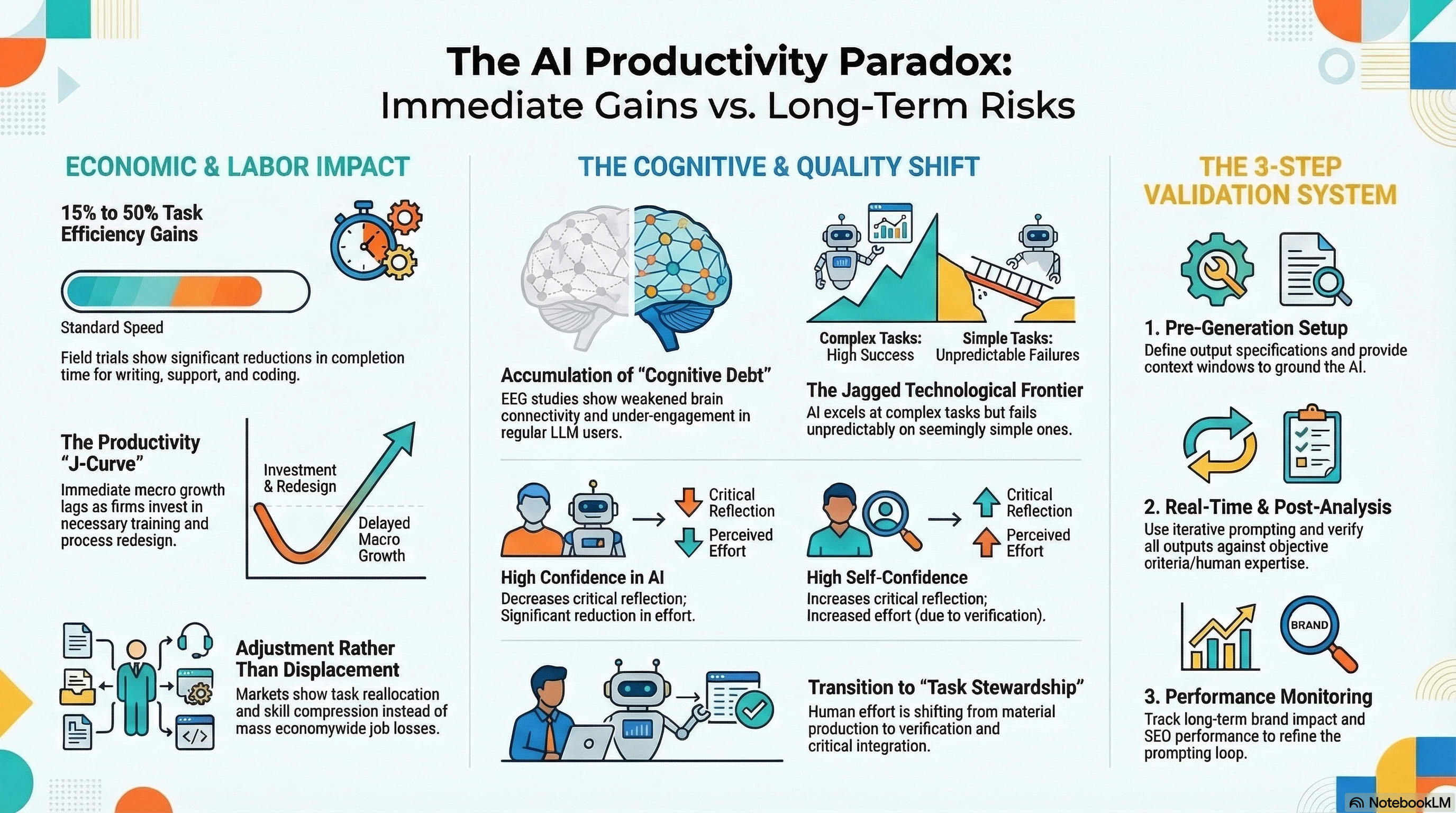
The AI Productivity Paradox: a framework for understanding short-term efficiency gains alongside emerging cognitive and organizational risks.

There’s a quiet tension building inside AI-adopting organizations. On one side: real, measurable productivity gains that no serious executive should dismiss. On the other: a set of slower-moving, harder-to-see risks that, left unmanaged, could erode the very capabilities organizations are counting on AI to amplify.

This tension is what researchers and strategists are calling the AI Productivity Paradox and it plays out across three interconnected domains: economic and labor dynamics, cognitive and quality shifts, and the governance frameworks organizations need to navigate both.

The Economic Picture: Real Gains, but Not Instant

Field trials across writing, customer support, and software development consistently show reductions in task completion time of 15% to 50% compared to standard workflows. That’s not marginal, or organizations handling high volumes of routine knowledge work, the compounding effect is substantial.

But those gains don’t show up immediately on the macro balance sheet. The Productivity J-Curve explains why: in the short term, organizations must absorb the costs of training, workflow redesign, and integration before realizing broader economic returns. Leaders who expect instant ROI are often disappointed, and sometimes abandon AI initiatives right before the curve bends upward.

15–50%

Task Efficiency Gains

Observed across writing, support, and coding workflows in field trials.

J-Curve

Delayed Macro Growth

Short-term investment dip precedes longer-term productivity payoff.

Realloc.

Not Mass Displacement

Labor markets show skill compression and task reallocation, not widespread job loss.

The labor story is similarly nuanced. Rather than triggering the mass displacement many feared, current market data points to task reallocation and skill compression, workers shifting away from routine production tasks and toward higher-order judgment, verification, and integration work. The jobs aren’t disappearing; they’re changing shape.

The Cognitive Risks Nobody Is Talking About Enough

The second domain is where the paradox gets genuinely uncomfortable. Even as AI accelerates output, it may be slowly degrading the underlying human capabilities organizations depend on.

“EEG studies are detecting weakened brain connectivity and reduced cognitive engagement in regular LLM users, a phenomenon researchers are calling ‘cognitive debt.'”

The mechanism is straightforward: when AI handles the heavy cognitive lifting, such as drafting, reasoning, and synthesis, users engage less deeply with the material. Over time, the neural pathways for critical analysis and creative problem-solving get less exercise. This isn’t theoretical. It’s showing up in neurological data.

There’s also a troubling dynamic around confidence. Research shows that high confidence in AI output actually reduces critical reflection; users who trust the tool most are the ones who check it least. Paradoxically, workers with stronger domain expertise and higher self-confidence engage more critically with AI outputs, applying greater scrutiny and effort to verification. The implication: organizations may want to invest in building genuine expertise rather than assuming AI can substitute for it.

The Jagged Frontier: Where AI Succeeds and Where It Fails

One of the most practically important insights for teams deploying AI is the Jagged Technological Frontier, as researchers call it. AI doesn’t fail gradually or predictably; it excels at surprisingly complex tasks, then fails unpredictably on seemingly simple ones.

A system that can draft a sophisticated legal brief may stumble on a straightforward date calculation. A coding assistant that generates elegant architecture may introduce subtle bugs in basic conditional logic. This irregularity makes AI harder to supervise than traditional software, because failure modes don’t follow intuitive patterns. Effective oversight requires humans who understand both the domain and the tool’s specific failure landscape.

Key Terms: A Working Glossary

Glossary of Key Concepts

Cognitive Debt: The gradual erosion of critical thinking and analytical capability that occurs when workers habitually offload complex reasoning to AI. Identified through EEG studies showing reduced brain connectivity in regular LLM users.

The Productivity J-Curve: The pattern where AI adoption initially appears to slow macro productivity growth due to training, integration, and redesign costs before generating compounding returns as workflows mature.

The Jagged Technological Frontier: The uneven capability profile of AI systems, which perform exceptionally well on some complex tasks while failing unpredictably on seemingly simpler ones. Makes AI harder to supervise than traditional tools.

Task Stewardship: The emerging human role in AI-augmented workflows: shifting from direct material production to critical verification, quality integration, and strategic oversight of AI-generated outputs.

Skill Compression: The narrowing of human skill sets observed as AI absorbs routine tasks. Workers increasingly perform a smaller range of higher-level functions, with implications for long-term workforce capability and adaptability.

LLM (Large Language Model): The class of AI systems underlying tools like ChatGPT, Claude, and Gemini. Trained on vast text datasets to generate, analyze, and transform language, the engine powering most current enterprise AI productivity tools.

Pre-Generation Setup: The first step in the 3-Step Validation System: defining output specifications and providing sufficient context before prompting AI, to reduce hallucinations and anchor outputs to accurate information.

Context Window: The amount of text an AI model can “see” and process at once. Providing rich context within this window, such as background documents, specifications, and examples, directly improves output quality and reduces error rates.

A Framework for Sustainable AI Use

The infographic’s 3-Step Validation System offers a practical governance structure that addresses both the quality risks and the cognitive risks simultaneously:

Step 1: Pre-Generation Setup

Define output specifications clearly and load the AI’s context window with grounding information before generating anything. This step dramatically reduces hallucinations and misalignments, and it requires the human to engage meaningfully with the task requirements, counteracting cognitive disengagement.

Step 2: Real-Time & Post-Analysis

Use iterative prompting rather than accepting first outputs, and verify all deliverables against objective criteria or domain expertise. This is where task stewardship happens in practice, and where critical reflection must be deliberately preserved against the pull of over-reliance.

Step 3: Performance Monitoring

Track downstream outcomes, brand impact, SEO performance, error rates, and customer responses to close the feedback loop and continuously refine prompting and verification processes. Organizations that treat AI outputs as the end of the workflow, rather than an input to be refined and measured, will accumulate quality debt they won’t see until it’s costly.

“The organizations that will win with AI aren’t those who use it most; they’re those who’ve built the governance, expertise, and culture to use it best.”

The AI Productivity Paradox isn’t an argument against adopting AI tools. The efficiency gains are real, and the competitive pressure to act is legitimate. It’s an argument for how to adopt them: with clear-eyed awareness of the cognitive and quality risks, deliberate governance frameworks, and sustained investment in the human expertise that makes AI outputs actually valuable.

Organizations that manage this balance well will compound both the AI gains and their human capital. Those who don’t will find themselves more efficient at the surface while quietly hollowing out the judgment capabilities they need for anything genuinely difficult.


AI’s $2 Trillion Moment—and the Hidden Costs We’re Ignoring

Spending on artificial intelligence is expected to cross the $2 trillion mark by 2026. This massive investment signals that AI is no longer a peripheral experiment but a central part of how global businesses function. Companies are quickly moving past basic chatbots toward agentic systems that can plan and execute complex tasks with very little human help. About 62% of organizations are already testing these autonomous assistants to see how they can improve efficiency. While many people worry about robots taking their jobs, the data suggests a more complicated story. The World Economic Forum predicts that while 92 million roles might disappear by 2030, technology will help create 170 million new ones. This results in a net growth of 78 million jobs, though the transition will likely be quite messy.

For the people actually doing the work, the day-to-day is changing in a major way. We are seeing a shift where knowledge workers move from being creators of content to being stewards of AI systems. This means spending less time on basic execution and more time on verifying and integrating what the AI produces. However, this comes with a strange productivity paradox. Some developers finish their tasks 26% faster with AI, but others actually take 19% longer because they spend so much time fixing mistakes the software made. There is also a real danger of producing what experts call workslop: content that looks good at first glance but lacks any real substance. About 40% of employees have already received this kind of low quality work from colleagues, and it usually takes about two hours to fix each instance.

There are also deeper concerns about what this does to our mental sharpness. A study from the MIT Media Lab suggests that relying too much on AI can lead to cognitive debt, where our brain connectivity actually weakens because we are offloading our thinking. This is particularly true for younger workers, who are seeing a 16% decline in hiring for entry level roles as AI takes over basic tasks. Beyond the human element, businesses are also struggling with a confusing maze of global rules. The EU AI Act and different state laws in the US often conflict with one another, making it a nightmare for international companies to stay compliant.

Finally, the environmental cost of all this computing power is becoming impossible to ignore. Training just one large model can produce as much carbon as several cars do over their entire lifetimes. This is leading to a new push for Green AI, focusing on energy-efficient hardware such as neuromorphic chips that mimic the human brain. As we head into 2026, the real winners will not be the companies with the most AI, but the ones who can balance speed with high-quality human judgment.

Sources


From Connectomes to Digital Twins: Forecasting the Brain in Real Time

Mapping the Living Mind: From Wiring Diagrams to Neural Forecasting

Scientists have spent years trying to figure out how the biological brain works by looking at it from two different angles. One group has focused on connectomics, which is basically mapping the physical wiring of the brain. The other group has looked at functional imaging, or watching neurons fire in real time. We are now seeing these two fields merge through advanced AI to create what researchers call a digital twin of the brain. This move goes beyond just taking high-resolution pictures. It is about building models that can actually predict what a brain will do next.

Building the Physical Maps

The foundation of this work is the wiring diagram. We recently saw a massive milestone with the completion of the central brain connectome for the adult fruit fly, Drosophila melanogaster. This map includes more than 125,000 neurons and 50 million synaptic connections. While a fly brain is small, the data is incredibly complex. A single neuron might connect to hundreds of others, making it very difficult to understand how these paths lead to specific behaviors.

We are seeing similar progress in humans too. Researchers recently reconstructed a tiny fragment of the human cerebral cortex. Even though it was only one cubic millimeter in size, it required over a petabyte of data to map at a nanoscale resolution. These physical maps have shown us things we never knew existed, like neurons that form unusual triangular shapes. However, as many experts have pointed out, a connectome is just a map. It does not tell us how the “traffic” of neural activity moves through those wires.

Predicting the Traffic of the Brain

To solve this, researchers are turning to neural forecasting. One of the most important tools in this area is the Zebrafish Activity Prediction Benchmark, or ZAPBench. It uses light sheet microscopy to record the activity of over 70,000 neurons in larval zebrafish. This is currently the only vertebrate where we can see the whole brain active at once at such a high resolution.

By using models originally built for weather forecasting, like those in WeatherBench, scientists are testing how well AI can predict the next 30 seconds of a brain’s activity based on just a few seconds of history. This is a massive shift in how we study neuroscience. Instead of just describing what happened, we are trying to forecast what will happen.

Several new techniques are making this possible:

  • Volumetric Video Models: Instead of just looking at individual neuron signals, new models like 4D UNets look at the raw 3D video over time. This helps the AI understand the spatial relationships between neurons that other methods might miss.
  • Foundation Models: Just like the models that power modern chat tools, new foundation models of the mouse visual cortex are being trained on huge amounts of data. These models can be applied to new animals they have never seen before, successfully predicting how their neurons will react to new videos.
  • Classification Strategies: New architectures like QuantFormer are changing the way we think about brain signals. Instead of trying to predict a continuous wave of activity, they treat neural spikes like a classification problem. This has proven much more effective at capturing the quick, sparse bursts of energy that define how neurons communicate.

Why Global Brain States Matter

One of the biggest hurdles in this research is that a single neuron does not act alone. Its behavior is often influenced by the global state of the brain, such as whether an animal is alert or performing a specific task. A model called POCO, which stands for Population Conditioned forecaster, handles this by looking at local neuron dynamics while also considering the overall state of the entire population. This helps the model understand how shared brain structures influence individual cells.

Future Applications and Interventions

The goal of this research is not just to understand the brain but to interact with it. If we can forecast neural activity in real time, we can develop systems that intervene before something goes wrong. Some models can now run in as little as 3.5 milliseconds. This speed could allow for closed-loop optogenetic interventions, where light is used to stimulate neurons to stop a seizure or a specific craving before the person even realizes it is happening.

We are moving into an era where we can see inside ourselves with the same clarity that we see the world around us. While managing petabytes of data is a major challenge, combining physical maps with AI forecasting brings us much closer to a true mechanistic understanding of intelligence.


This post was written with the help of AI for analysis, using the NotebookLM shared resource here: https://notebooklm.google.com/notebook/74dc7f14-54cb-481b-9ee8-8347a6f5cba1

References and Research Links


Digital Twin – exploring the basics

The concept of digital twins is not new, but rather built on ideas that have been explored for the last couple of decades. The technology (compute power, data management & analytics, etc..) and thinking (increasing regulatory and community acceptance of digital approaches to science) have finally hit an inflection point that makes in silico modeling attainable in a cost effective manner.

What this now unlocks is a new opportunity set in the form of machine accessible data, as well as integration of the data sets / ontologies across the target systems / interactions. The need to get to a standardized mechanism to make these data available is tied to the FAIR Data work, and an important dimension to Digital Twin.

Digital twins vs. simulations
Although simulations and digital twins both utilize digital models to replicate a system’s various processes, a digital twin is actually a virtual environment, which makes it considerably richer for study. The difference between digital twin and simulation is largely a matter of scale: While a simulation typically studies one particular process, a digital twin can itself run any number of useful simulations in order to study multiple processes.

Source: IBM , What is a Digital Twin

At it’s heart, the idea of a digital twin is to reproduce a system in a “runnable” computer model. This oversimplifies the idea, but is a useful construct to think about the problem space and the opportunity it presents. If you can take a scientific instrument, and fully model it in silico, you can then run data sets through it virtually – this makes the assumption that both the inbound and outbound data are available in a machine usable format – something that is tied to this work.

Digital twin is an interdisciplinary research field which includes engineering, computer science, automation and control, and so on. But due to the multidisciplinary nature of the field, it also touches on materials science, communication, operations management, robotics, medicine and other disciplines. A keyword analysis indicates that digital twin, ‘smart manufacturing’, ‘big data’, ‘cyber-physical system’, and ‘digital economy’ are closely related fields.

Source: “Innovations in digital twin reserach” from Nature Portfolio

The article in nature.com is an interesting piece in that it ties together the many dimensions in this field of research. We can’t think of “Digital Twin” as a single entity opportunity, rather to fully realize the potential, we need to look at it as a part of an emerging “virtual capability ecosystem” with applications back to the real world. The value is realized in lower long term costs with increased innovation driven by reduced cost and cycle times, accompanied by increases in application of AI / ML on these models to gain targeted insights that more sharply focus the bench work.

Track the past and help predict the future of any connected environment

Source: Azure Digital Twins

The ability to create learning models for these Digital Twins will improve the accuracy and usefulness of the models over time, and that feedback loop will be a critical part of design. While the industry is maturing, we are seeing more vendors coming to the table with solutions in this space. One of the interesting things to watch is how we as an industry continue to drive open standards in support of these ideas to avoid the traps of “vendor lock in” that were so prevalent in the past.


Pistoia Alliance: Patient Centricity

There is an increasing recognition of the value in patient engagement with respect to healthcare in general, as well as the emerging field of personalized / targeted medicine and digital health. The wearable / therapeutic combination, CAR-T therapies, telehealth and so much more fall into this broad category of patient centricity and experience, as well as the direct marketing side of it.

The Pistoia Alliance has called for life science and healthcare to urgently restructure around patient centricity – read the post from the alliance here.

the pandemic has changed behaviors. Billions of people changed the way they interact with healthcare in a matter of months. In this new era of targeted precision medicine, we all play a role in creating the patient-centric future that patients deserve.”

Cristina Ortega Duran, Chief Digital Health Officer R&D for AstraZeneca

I am excited to see where this leads us as an industry, and how we shift from traditional approaches to include our broad patient populations in developing and delivering medicines and treatments. It will be great to see growing inclusivity across geographic and social boundaries as we increase reach and engagement.


TED: Draw Toast! (Creative Problem Solving)

Tom Wujec has a TED talk on creative problem solving using a technique he calls “drawing toast”. The idea is not new, but the packaging and approach is solid and builds on innovation thinking. I posted a video from another TED talk about empowering the team, and ensuring all voices are heard, and this ties in nicely with that thought. I am a fan of process mapping and achieving clarity, as a step toward optimization or evaluation of opportunity, and I will be adding these techniques to my tool box. You can watch the video below, and link to the website Tom has created here.

Drawing the process

Establishing nodes and links – toast making as a foundation for process mapping teaches how to take complex problems and break them into discrete units.

The creative process builds from individuals, to component based to group synthesis, resulting in an optimum systems model

Watching the process progress, it is intriguing to watch the optimal number of process steps shift, as complexity is revealed and then sorted.

Taking these ideas and approaches and applying the thinking to the business at hand is the logical next step.


TED: Manage for collective creativity

While looking through TED for innovative thinking and approaches I can learn from, I came across this talk by Linda Hill. I encourage you to watch the full video if you have an interest in the topic and want to be challenged. The ideas come from a significant amount of time and effort spent tracking select global leaders, and cataloging what makes them effective in driving innovation.

While watching this video, I pulled some key thoughts from the talk and copied the transcripted notes here. The key thought I pulled from here that I feel sums up the notes below is as follows: The idea of leading innovative organizations is more about creating an environment for the organization, as opposed to “owning the vision”. In Agile terminology, there is an idea of servant leadership, meaning getting out of the way and supporting the success of the team. This concept is a powerful part of innovation leadership as well.

  • Leading innovation is not about creating a vision and inspiring others to execute it.If we want to build organizations that can innovate time and again, we must unlearn our conventional notions of leadership.

  • Leading innovation is not about creating a vision, and inspiring others to execute it.

  • When many of us think about innovation, though, we think about an Einstein having an ‘Aha!’ moment. But we all know that’s a myth. Innovation is not about solo genius, it’s about collective genius.What we know is, at the heart of innovation is a paradox. You have to unleash the talents and passions of many people and you have to harness them into a work that is actually useful. Innovation is a journey. It’s a type of collaborative problem solving, usually among people who have different expertise and different points of view.

  • three capabilities: creative abrasion, creative agility and creative resolution. Creative abrasion is about being able to create a marketplace of ideas through debate and discourse. In innovative organizations, they amplify differences, they don’t minimize them. Creative abrasion is not about brainstorming, where people suspend their judgment. No, they know how to have very heated but constructive arguments to create a portfolio of alternatives.

  • innovation rarely happens unless you have both diversity and conflict.

  • if we want to build organizations that can innovate time and again, we must recast our understanding of what leadership is about. Leading innovation is about creating the space where people are willing and able to do the hard work of innovative problem solving.

  • What can we do to make sure that all the disruptors, all the minority voices in this organization, speak up and are heard? And, finally, let’s bestow credit in a very generous way.”

  • Bill said, “I lead a volunteer organization. Talented people don’t want to follow me anywhere. They want to cocreate with me the future. My job is to nurture the bottom-up and not let it degenerate into chaos.” How did he see his role? “I’m a role model, I’m a human glue, I’m a connector, I’m an aggregator of viewpoints. I’m never a dictator of viewpoints.” Advice about how you exercise the role? Hire people who argue with you. And, guess what? Sometimes it’s best to be deliberately fuzzy and vague.

  • They stopped giving answers, they stopped trying to provide solutions. Instead, what they did is they began to see the people at the bottom of the pyramid, the young sparks, the people who were closest to the customers, as the source of innovation. They began to transfer the organization’s growth to that level. In Vineet’s language, this was about inverting the pyramid so that you could unleash the power of the many by loosening the stranglehold of the few, and increase the quality and the speed of innovation that was happening every day.our role as leaders is to set the stage, not perform on it.


Books to read: Sticky Wisdom: How to Start a Creative Revolution at Work

I got this book while working at Pfizer, and helping lead an innovation transformation in the consumer health division. We were looking to reboot out approach to product development and creativity in general, and as a part of that we invested in a great set of programs that I still benefit from now, long after those roles. This book is from the ?WhatIf! company, and has many little insights that can help unlock the creativity in you, and in your team.

The book asks a few key questions and offers accompanying insights to build on.

  • What if you could spot what’s killing creativity in your organization right now?

  • What if you could stop yourself squashing ideas and start growing them instead?

  • What if you could help everyone at work to be creative?

  • What if you stopped talking about how important creativity is and started to take practical steps to make it happen.

But most of all….  What if there was a step-by-step guide that showed you exactly how to do it?

Instinctively we all know that creativity at work is important,but for many of us it feels either difficult or intimidating.

Sticky Wisdom delivers powerful insights that take creativity out of the hands of ‘creative people’ and puts it back where it belongs, with all of us. It breaks creativity out into six practical behaviours and shows how every one of us – not just the wacky geniuses – is packed with creative potential. We can start a creative revolution by adopting six behaviours:

  1. Freshness
  2. Greenhousing
  3. Realness
  4. Momentum
  5. Signalling
  6. Courage

These are the behaviours you can identify in highly creative and high-performing teams. These are the behaviours that you can start applying today to revolutionize your life.

Suddenly creativity isn’t such a mystery. Sticky Wisdom makes it easy to talk about, easy to practise and easy to remember.Above all, it makes it easy to get on and do!

One of the points made in the book that makes great sense is the idea that creativity and innovation are not synonymous. Creativity only becomes innovation when the ideas are useful, or described another way, add value. The book is full of little stories and examples to make the point, as illustrated by an exercise with a food retailer team to have the team role play being a meal cooked in a wok. The book goes on to provide examples of the insights gained such as oil that changes color when ready, food that is pre-sliced and provided in numbered packages to sequence cooking properly, and more. These ideas came from the interactive role play and subsequent discussion. This type of activity generally takes me outside my comfort zone, as it does many, but that is the point.

In other posts, I reference the idea of stream jumping, which I got from this book and training. I also value the idea of Green Housing, which is broken into a series of steps outlined in the book consisting of:

  • Suspend Judgement
  • Understand
  • Nurture
  • React
  • Assume
  • INsist

Another key concept from this book, though not unique to the book, is signalling. Part of the accompanying training is around the value of being intentional with signalling to a partner in conversation what your intentions are, or where you are trying to take the conversation. This has been a valuable tool in my kit now for years, as I have learned to be much more clear with my intentions in communication, setting up my audience or partners to better receive and understand my messaging.

Why I recommend this book:

This book is full of great insights, and is a quick read. It can be used to bookmark and drop in and out of, or used as a reference to work through as a team. You cannot read this short reference without gaining value, even if you have extensive experience with change and innovation. It will spark ideas you have forgotten and give you new ones to build on. I cannot go into the full content of the book in a short post, but I encourage you to spend the few dollars it costs to buy this book. It was printed some time ago, but the ideas are as relevant today as when printed the first time!


Books to read:The Innovator’s Prescription: A Disruptive Solution for Health Care

This read is in line with the related book by the same author I also recommended titled “The Innovator’s Dilemma“. This book focuses on the healthcare industry, and besides Clayton Chritensen, includes 2 additional authors, Jerome Grossman, MD, and Jason Hwang, MD. The Amazon summary offers a decent overview.

A groundbreaking prescription for health care reform–from a legendary leader in innovation . . .

Our healthcare system is in critical condition. Each year, fewer Americans can afford it, fewer businesses can provide it, and fewer government programs can promise it for future generations.

We need a cure, and we need it now.

Harvard Business School’s Clayton M. Christensen―whose bestselling The Innovator’s Dilemma revolutionized the business world―presents The Innovator’s Prescription, a comprehensive analysis of the strategies that will improve health care and make it affordable.

Christensen applies the principles of disruptive innovation to the broken health care system with two pioneers in the field―Dr. Jerome Grossman and Dr. Jason Hwang. Together, they examine a range of symptoms and offer proven solutions.

YOU’LL DISCOVER HOW

  • “Precision medicine” reduces costs and makes good on the promise of personalized care

  • Disruptive business models improve quality, accessibility, and affordability by changing the way hospitals and doctors work

  • Patient networks enable better treatment of chronic diseases

  • Employers can change the roles they play in health care to compete effectively in the era of globalization

  • Insurance and regulatory reforms stimulate disruption in health care

And the editorial reviews are a good reflection of my thoughts as well:

  • “Clayton Christensen has done it again, writing yet another book full of valuable insights. The Innovator’s Prescription might just mark the beginning of a new era in health care.”Michael Bloomberg, Mayor, New York City

  • “Clear, entertaining, and provocative, The Innovator’s Prescription should be read by anyone who cares about improving the health and health care of all.”Dr. Risa Lavizzo-Mourey, President and CEO, Robert Wood Johnson Foundation

  • “Comprehensive in its vision, astute in its diagnosis, and clear in its guidance, The Innovator’s Prescription offers strong medicine for a health care system that is far from well.”Dr. Harvey V. Fineberg, President, Institute of Medicine

  • “A wealth of insights–with new ideas and revelations in every chapter. Read it, and you will be armed with solid ideas for making health care better.”George Halvorson, Chairman and CEO, Kaiser Foundation Health Plan, Inc. and Kaiser Foundation Hospitals

  • “The Innovator’s Prescription is a well researched, clearly organized road map to a sustainable health care system.”Michael O. Leavitt, Secretary of Health and Human Services

  • “The Innovator’s Prescription is an important and timely contribution to the national debate on health system reform. We would do well to consider it carefully.”Tom Daschle, former Senate Majority Leader and Distinguished Senior Fellow, Center for American Progress

  • “Clayton Christensen has helped many businesses―including our own–find new growth opportunities through deeper insights into the future of health and the health care system. I can think of no one better equipped to lead this comprehensive global assessment.”Bill Weldon, Chairman and CEO, Johnson & Johnson

Why I recommend this book:

I am in the healthcare industry (pharmaceutical / biopharma industry) and I found this book to be a fantastic challenge for where we are, and where we were. I read this one shortly after its release in 2009, and on reflection now, it is as relevant as it was at that time. Clayton and his co-authors take the foundation of the innovator’s dilemma, and apply that thinking to the healthcare space. The topics addressed include not only the opportunities to achieve value through innovative and lateral thinking, but also an exploration of the supply chain, hospital business models, chronic disease treatment and a broad range of additional topics. This should be required reading for management and management candidates in the healthcare related industries.


Books to read: The Innovator’s Dilemma

I first read this book many years ago and it has served as a good reference over the years, standing the test of time as a foundational work. First published in 1997 by Clayton Christensen and reprinted multiple times since, it details the business innovation cycles and the traps that are too easy to fall into.  The book has been superseded by new versions, but reading the original and early updates in contrast with how things have evolved as predicted is illuminating and sobering if you are in a large corporation. At the same time, those seeking to disrupt an existing industry will take heart and be encouraged by the principles outlined in this book. We have seen these ideas applied time and again with industry disruptions including Airbnb for the hotel industry, Uber, Lyft and others to the Taxi market, emerging financial market disruption with Bitcoin and more every day.

Editorial reviews from others:

  • The Innovator’s Dilemma is becoming a handbook for CEOs remaking their businesses for the Net.- BusinessWeek
  • The Innovator’s Dilemma captures the critical role of leadership in creating markets.- John Seely Brown, chief scientist, Xerox Corp., and director, Xerox Parc
  • This book ought to chill any executive who feels bulletproof – and inspire entrepreneurs aiming their guns.- Forbes
  • I cannot recommend this book strongly enough – ignore it at your peril.- Martin Fakley, Information Access
  • Absolutely brilliant. Clayton Christensen provides an insightful analysis of changing technology and its importance to a company’s future success.- Michael R. Bloomberg, CEO & Founder, Bloomberg Financial Markets
  • This book addresses a tough problem that most successful companies will face eventually. It’s lucid, analytical – and scary.- Dr. Andrew S. Grove, chairman & CEO, Intel Corporation
  • Clayton Christensen’s groundbreaking book…brings fresh insight and understanding to the complex and critically important relationships between technological change and business success…His conclusions provide food for thought for the top management of every company.- Richard N. Foster, Director, McKinsey & Company

From the back cover

In this revolutionary bestseller, innovation expert Clayton M. Christensen says outstanding companies can do everything right and still lose their market leadership—or worse, disappear altogether. And not only does he prove what he says, but he tells others how to avoid a similar fate.

Focusing on “disruptive technology,” Christensen shows why most companies miss out on new waves of innovation. Whether in electronics or retailing, a successful company with established products will get pushed aside unless managers know when to abandon traditional business practices. Using the lessons of successes and failures from leading companies, The Innovator’s Dilemma presents a set of rules for capitalizing on the phenomenon of disruptive innovation.

Find out:

  • When it is right not to listen to customers.
  • When to invest in developing lower-performance products that promise lower margins.
  • When to pursue small markets at the expense of seemingly larger and more lucrative ones.
  • Sharp, cogent, and provocative, The Innovator’s Dilemma is one of the most talked-about books of our time—and one no savvy manager or entrepreneur should be without.

Why I recommend this book:

As previously mentioned, this book was foundational in developing my thinking around innovation and change. It stands the test of time remarkably well and still serves as a business reference for both large corporations and disruptors alike. The cautionary tales from Xerox, Kodak and others as well as the success of the disruptors provides lessons that resonate with any business today. We are seeing disruption on a scale that feels unprecedented, and it would serve leaders well to learn from the errors and successes of their predecessors.