Design Thinking

Design thinking is an approach that can be stand alone or a critical part if an agile delivery approach. It is at it’s heart, about inspecting and adapting, using iterative approaches to build value. The approach offers a number of great benefits, to include:

  • Quicker Starts – Since there does not need to be a robust final design spec prior to starting the iteration process, the team can get to real value much more quickly, focusing on the priority items as opposed to everything at once.
  • Clarity on purpose / objective – as the team starts the design process, the iterative and testing nature will help the group and owner try and discard multiple ideas and approaches, honing in on the highest value and driving clarity on what is important, as well as what is urgent, meaning a priority for initial value focus.
  • Needs driven development / investment – This is really an outcome of the prior value. As clarity and priority is achieved, the team will focus on what is next in line, and delivering the most value to the target outcome.
  • Reduction in “pet features”, meaning the ability to iteratively add value, and not have to have everything you MIGHT need defined up front prior to requirements lock allows product owners to be more selective in what they allow into the development cycle.  
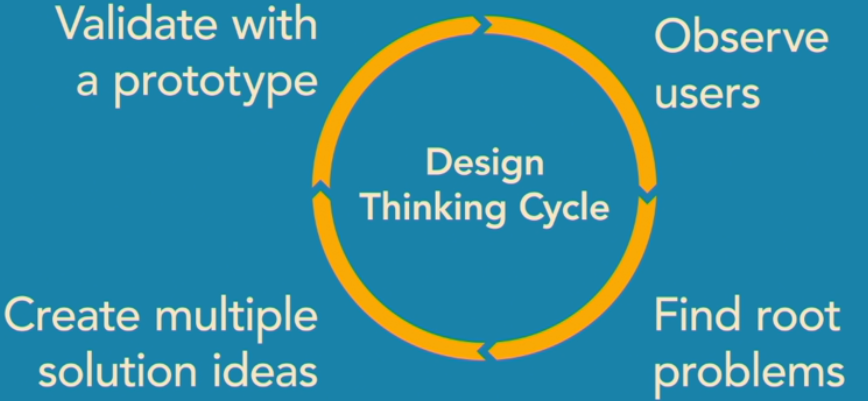
Design Thinking Flow
Image Source: Presentation from Chris Nodder

To be successful, the product owner and lead needs to set clear goals as well as success, or acceptance criteria for these. As these are declared, the team must measure the results, early & often. This feedback on results loop will allow the team to test the ideas and have value stories to tell, with real world feedback that is incredibly powerful.

Having led teams and worked in large enterprises for a couple of decades, I see many people who are a bit jaded and do not see themselves as creative. What I have found though, is that most people are creative when properly stimulated and often welcome the opportunity to contribute and be a part of a solution and ideation process. As a design thinker, it is important to learn to harness this process and enthusiasm. The white board and sticky note approach, as well as sketching on paper provides safe ways to start the ideation, and can open the door to creative thinking.

The low fidelity ideation drives collaboration and conversation, while also saving money and time. Paper prototypes are a great way to do an idea walk through and pressure test User Interface (UI) or work flows.

The risk of the waterfall mentality, meaning the standard step wise life cycle methodology is real, but can be mitigated to some level but following a lean / agile approach with an iterative startup phase. 

The value of failing fast, applying learnings is tremendous, as described previously. You can expect to see results such as:

  • Clearer cost estimation – ideas are tested and thought through
  • Reduced risk – fast failure is much lest costly failure
  • Improved Communication – the high collaboration required for design thinking forces good communication from the start, creating a solid foundation for a team to interact across levels. 
  • Faster time to market, with the highest value elements. – there is still a long tail, but the work is now focused on the value elements as opposed to the waste, and the team can terminate once the target value or capability has been met, as opposed to building, debugging and testing features that are no longer useful.

Getting started does not require a large enterprise commitment, or even a strong management endorsement. Just start – don’t make it a big deal or seek to justify, let the results do the speaking / marketing for your team. People are attracted to success, and success breeds more success creating a “pull through”.

As the thinking and process takes hold, you can work on the organization sell through. 

  • By identifying key influencers from each group you work with, you can make them part of the process, and part owners of the success. 
  • Meet face to face and explain the process, as well as the value. The face time allows you to pull out some paper and a pencil, and walk through the approach, demonstrating the design thinking in your message!
  • As you engage, explore the dominate challenges with the current process that your team or stake holder are familiar with. There are usually a number of clear pain points around start up time, risk incurred, long “dark windows” of development time, and long tails of debugging and delays.
  • The conversation opens the door to explain & explore how design thinking removes or mitigates those issues by providing much tighter engagement, ownership and communication as well as a value focus!

There is so much more that can be said on this topic, as well as the clear intersection with the agile world and approach, but this is a good initial exploration to get you started on the journey.


Agile Manifesto

The Manifesto for Agile Software Development came out of a discussion among 17 people in the Utah mountains. The story around the start in the Snowbird  ski resort is an interesting read, but fundamentally it is about looking for a better way of doing software development, and by extension, almost any other delivery activity.

Agile is a simple idea at its heart, though an entire industry has sprung up around the idea and approach, in many cases, making it anything but agile!

The Manifesto for Agile Software Development is as follows

We are uncovering better ways of developing
software by doing it and helping others do it.
Through this work we have come to value:

Individuals and interactions over processes and tools
Working software over comprehensive documentation
Customer collaboration over contract negotiation
Responding to change over following a plan

That is, while there is value in the items on the right, we value the items on the left more.


Principles behind the Agile Manifesto

The Agile Manifesto is backed or supported by 12 principles that describe the implementation approach. As mentioned in a related post, Agile is often blown up to a far more complex idea, with a misguided thinking that to be agile it means certain tools, specific techniques or other miscellaneous trivia. At its heart, the idea is simple and compelling. Breaking down the principles makes that clear, as you can see the roots in other approaches rolled up into this manifesto and related principles.

We follow these principles:  (Emphasis added by me)

  1. Our highest priority is to satisfy the customer through early and continuous delivery of valuable software.
  2. Welcome changing requirements, even late in development. Agile processes harness change for the customer’s competitive advantage.
  3. Deliver working software frequently, from a couple of weeks to a couple of months, with a preference to the shorter timescale.
  4. Business people and developers must work together daily throughout the project.
  5. Build projects around motivated individuals. Give them the environment and support they need, and trust them to get the job done.
  6. The most efficient and effective method of conveying information to and within a development team is face-to-face conversation.
  7. Working software is the primary measure of progress.
  8. Agile processes promote sustainable development. The sponsors, developers, and users should be able to maintain a constant pace indefinitely.
  9. Continuous attention to technical excellence and good design enhances agility.
  10. Simplicity–the art of maximizing the amount of work not done–is essential.
  11. The best architectures, requirements, and designs emerge from self-organizing teams.
  12. At regular intervals, the team reflects on how to become more effective, then tunes and adjusts its behavior accordingly.

Agile takes multiple forms, and a couple of the most common are the foundations of many more. Kanban is a more sequence driven form, and Scrum is probably the most common team & sprint based approach. 

There are a variety of tools used to aid in the management of agile projects, but the clear leader is the Atlassian tool called Jira. Of course, Excel is a fast follower as well in the spirit of keeping it simple!

I will post more on this topic, as I am in the middle of helping to drive an Agile Transformation in our enterprise R&D area. We have baselined our current approach and now my team is asking “why not agile” as opposed to “why agile” or assuming waterfall as the delivery process. 


TED: Draw Toast! (Creative Problem Solving)

Tom Wujec has a TED talk on creative problem solving using a technique he calls “drawing toast”. The idea is not new, but the packaging and approach is solid and builds on innovation thinking. I posted a video from another TED talk about empowering the team, and ensuring all voices are heard, and this ties in nicely with that thought. I am a fan of process mapping and achieving clarity, as a step toward optimization or evaluation of opportunity, and I will be adding these techniques to my tool box. You can watch the video below, and link to the website Tom has created here.

Drawing the process

Establishing nodes and links – toast making as a foundation for process mapping teaches how to take complex problems and break them into discrete units.

The creative process builds from individuals, to component based to group synthesis, resulting in an optimum systems model

Watching the process progress, it is intriguing to watch the optimal number of process steps shift, as complexity is revealed and then sorted.

Taking these ideas and approaches and applying the thinking to the business at hand is the logical next step.


Books to read: Sticky Wisdom: How to Start a Creative Revolution at Work

I got this book while working at Pfizer, and helping lead an innovation transformation in the consumer health division. We were looking to reboot out approach to product development and creativity in general, and as a part of that we invested in a great set of programs that I still benefit from now, long after those roles. This book is from the ?WhatIf! company, and has many little insights that can help unlock the creativity in you, and in your team.

The book asks a few key questions and offers accompanying insights to build on.

  • What if you could spot what’s killing creativity in your organization right now?

  • What if you could stop yourself squashing ideas and start growing them instead?

  • What if you could help everyone at work to be creative?

  • What if you stopped talking about how important creativity is and started to take practical steps to make it happen.

But most of all….  What if there was a step-by-step guide that showed you exactly how to do it?

Instinctively we all know that creativity at work is important,but for many of us it feels either difficult or intimidating.

Sticky Wisdom delivers powerful insights that take creativity out of the hands of ‘creative people’ and puts it back where it belongs, with all of us. It breaks creativity out into six practical behaviours and shows how every one of us – not just the wacky geniuses – is packed with creative potential. We can start a creative revolution by adopting six behaviours:

  1. Freshness
  2. Greenhousing
  3. Realness
  4. Momentum
  5. Signalling
  6. Courage

These are the behaviours you can identify in highly creative and high-performing teams. These are the behaviours that you can start applying today to revolutionize your life.

Suddenly creativity isn’t such a mystery. Sticky Wisdom makes it easy to talk about, easy to practise and easy to remember.Above all, it makes it easy to get on and do!

One of the points made in the book that makes great sense is the idea that creativity and innovation are not synonymous. Creativity only becomes innovation when the ideas are useful, or described another way, add value. The book is full of little stories and examples to make the point, as illustrated by an exercise with a food retailer team to have the team role play being a meal cooked in a wok. The book goes on to provide examples of the insights gained such as oil that changes color when ready, food that is pre-sliced and provided in numbered packages to sequence cooking properly, and more. These ideas came from the interactive role play and subsequent discussion. This type of activity generally takes me outside my comfort zone, as it does many, but that is the point.

In other posts, I reference the idea of stream jumping, which I got from this book and training. I also value the idea of Green Housing, which is broken into a series of steps outlined in the book consisting of:

  • Suspend Judgement
  • Understand
  • Nurture
  • React
  • Assume
  • INsist

Another key concept from this book, though not unique to the book, is signalling. Part of the accompanying training is around the value of being intentional with signalling to a partner in conversation what your intentions are, or where you are trying to take the conversation. This has been a valuable tool in my kit now for years, as I have learned to be much more clear with my intentions in communication, setting up my audience or partners to better receive and understand my messaging.

Why I recommend this book:

This book is full of great insights, and is a quick read. It can be used to bookmark and drop in and out of, or used as a reference to work through as a team. You cannot read this short reference without gaining value, even if you have extensive experience with change and innovation. It will spark ideas you have forgotten and give you new ones to build on. I cannot go into the full content of the book in a short post, but I encourage you to spend the few dollars it costs to buy this book. It was printed some time ago, but the ideas are as relevant today as when printed the first time!


Adapt to survive, or adapt to win…

There are more articles, papers and consultants than I can count on the topic of transformation in business. Many of them focus on the idea of transformation, and now especially “digital transformation” as a means of survival. I suggest an alternative, but complimentary idea. Don’t think of transformation as a survival exercise. Use transformation as a vehicle to truly be transformational, not in the buzzword sense, but rather in the overall value chain perspective.

To transform to survive is relatively straightforward. Look at where your peers are going, and queue up alongside them at the industry feeding trough. You will have a shot at staying relevant for a period, but your investment will likely be drowned out by the noise of the accompanying industry shifts, and be no longer lasting than the last series of “revolutionary ideas” the organization has moved through in the past. Transformative change comes from taking a hard look at your own house, industry, supply chain, and customers.

  • What are the trends in your industry pointing to?
  • What is your risk tolerance? (organizational, industry, regulatory …)
  • What are the trends across adjacent spaces that move more nimbly than your own?
    • How can you choose to leapfrog your competition and industry by making bold investments, while mitigating some level of risk by learning from adjacent spaces?
  • Is your broader organization ready to accept your changes?

Trends in your industry

The trends in your industry point to where your peers are headed. This is good information directionally, but also a map to “what is” as opposed to “what could be”. Use this as a means to cross check your ideas – are they closely aligned? If the answer is yes, you are likely transforming to survive.

How can you take a leadership position in your industry, partnering with your consumers / customers and your respective regulatory bodies to bring the consumer ever closer to the value? For heavily regulated industries, how can you ensure regulations evolve along with your technological investments? Be a trendsetter through partnerships with the regulatory agencies. Gain the competitive advantages from being positioned to take advantage of emerging legislations and changes.

The idea of adapting to win comes from being bold, and as a part of that, being a thought leader. This comes with risk, which leads to the next point.

What is your risk tolerance?

I learned many years ago to assess my risk tolerance for any given initiative, and to share that information with other senior leaders for confirmation and alignment. I have seen doors open that previously were firmly shut, once risk tolerance was understood and accepted. Conversely this also serves as a set of organizational guard rails to ensure that the proper foundation is set prior to embarking on your change event. Thinking through the risk, communicating the value of the risk and potential upside to the right stakeholders will set the change event up for maximum success. This is a topic all on its own, and something to give real thought to. Risk management should be thought of as a tool, and something to actively own as opposed to something to avoid if you are to grow.

Trends across adjacent spaces

Examining your own industry can be informative, but taking a hard look at industries that are much less regulated, or less constrained and closer to the forefront of technology and engagement is the key to starting to build your vision. To chart a course for transformation, a leader must have some idea of the future possibilities for the organization. A “North Star” must be defined, and a vision that can be clearly understood articulated. To do that, pointing to success sets up a believable path for your own industry and makes the unbelievable more realistic in the minds of your stakeholders. The adjacent spaces will likely have forward thinking that is not hindered by the regulatory or other structural burdens of your industry, and hence you as a leader are responsible to building the bridge of believability to get there, using your risk tolerance and vision as a foundation.

Is your broader organization ready to accept your changes?

The question of change readiness is a difficult one to face for many organizations, and is difficult enough at the project level, and even more so at the organizational change level. There is an element of “the org will do what I say”, to be sure, but real change will come from the people in the organization getting behind the mission, and both understanding and supporting the transformation activities. To gain this support, a non-trivial amount of up front work is required as well as continuous change management through the life of the actual transformation, and then well beyond the “done date”. The real value to be extracted from this significant investment comes in the “run state” of the new model. To get that, plan to invest in long running change management, voice of the customer and “micro tweaks” as well as highlighting the value in broad messaging.

Focus on the people, celebrate those team members who are bold and join the change as leaders, but do not forget those in the back who are supporting the leaders. People deliver on what is rewarded and celebrated. If as a leader, you celebrate “done” at the org alignment milestone and then resume business, you will miss the sustaining value of the change. Plan for a long tail on the investment. This is a real financial investment, but without it, plan to gain minimal transformative value.

Properly nurtured, the change event will result in a lasting difference in your organization and its ability to deliver meaningful value to your stakeholders. Remember to set a clear and compelling vision, and then measure yourself and your organization against that on on a regular basis. Celebrate success, support the change and be prepared to hold the course when things are difficult!


Digital Transformation… by any other name? Learning from other industries

I was reading an article at CIO Dive about the CIO at cosmetics conglomerate Estée Lauder Companies Inc. and it resonated with a transformation we are undertaking in the pharmaceutical industry. The thing I love about these types of situations is the broad applicability of good thinking, but also the value of “stream jumping”, a term I picked up from an agency I worked with in a past role focused on innovation. The key idea of this stream jumping is taking lessons from adjacent spaces and applying them to your challenges, not being constrained to “my industry”.

In the article, the author Mitch Betts says: Michael Smith joined the New York-based “prestige beauty” company as senior vice president and chief information officer, information technology last year, with a mandate for pushing IT innovation to help the company stay abreast of the fast-moving beauty industry, where an Instagram photo of celebrity’s new lip gloss can drive sales.

While the drug industry is not reactive to that degree, our engagement is around delivering life saving medicines as quickly and effectively as possible. As a part of that journey, the patient connection is taking an ever more prominent role, whether it be in the trial compliance or reporting, medical routine compliance, or health monitoring, or any of a number of other scenarios.

Mr. Betts lists the year one accomplishments for the CIO and his team.

  1. Reorganizing IT to align with business units, instead of technologies, so IT stays can stay close to business needs.
  2. Hiring IT talent, globally, with new skill sets.
  3. Fostering greater IT agility and speed, such as moving from waterfall to agile software development processes, and breaking down walls between applications and infrastructure groups to adopt DevOps.
  4. Moving from a buy-and-integrate IT strategy to building systems in-house when they provide a competitive advantage

It is interesting to see the pendulum swing on these principles, as over time I have seen a few of these move in and out of favor.  What is particularly encouraging is the recognition of the value of Agile software development and DevOps. This helps de-risk some of the moves to build vs buy and business unit alignment of IT functions.

The classic waterfall model tends to drive a centralized service mindset, and long lead to value cycle times, which creates a host of challenges in meeting expectations, both customer facing and internal delivery team focused. When coupled with decentralized business alignment, it creates a continuous conflict for service time, and generally leads to infighting in my past experience. It is possible to make it work, but the effort expended is not commensurate with the value returned.

An agile approach, coupled with decentralized IT staffing can potentially yield optimum results, however there is opportunity to drive efficiencies into the model through replication of core services. The ideal match for this approach would be a scalable, SLA driven managed service provider approach to the commodity centralized services – “classic IT”, while devoting the employee headcount and leadership to the business facing roles and the intersection roles.

Every managed service has an inward facing employee accountable for performance. These leaders are measured by each business facing lead, as well as the internal metrics. This will help ensure a balance of efficiency vs. effectiveness in delivery of value, while taking the complexity of scaling and growth off the plate of the business facing teams.

The article does not go into any detail about the specifics of the alignment, but this is yet another in the trend I am seeing around the recognition of the value in taking an agile approach, and adopting agile development practices. This concept scales beyond the software development, to collaboration, organization and most other value streams.

This transformation for Estée Lauder, as well as the others in flight, will be interesting to watch over the next year. This is especially true as we are in the beginning stages of our own internal changes!

Link to the original article